

Cold Spring Harbor Laboratory
Suffolk County

Energy Master Planning
Founded in 1890 and home to eight Nobel Prize winners, Cold Spring Harbor Laboratory sought ways to reduce its greenhouse gas emissions in alignment with the State of New York’s clean energy transition. The institution received NYSERDA funding through FlexTech for an ASHRAE Level II energy audit that ultimately led to an energy master plan, which, if fully implemented, will help the institution achieve a 21% reduction in greenhouse gas emissions by 2030 against a 2019 baseline.
Campus Characteristics
- Location: Laurel Hollow, Long Island
- Founding year: 1890
- Total enrollment: 100
- Campus size: 110 acres
- Institution type: private
- Highest degree: doctoral
Key Metrics

- Current utility costs ~$5 million annually
- $1.4 million annual savings if measures are implemented (a 28% cost savings)

- LED lighting
- Controls
- Retrocommissioning
- HVAC upgrades
- Plumbing upgrades

- Expected 21% reduction in greenhouse gas emissions by 2030 against a 2019 baseline
Figure. — Cold Spring Harbor Laboratory’s reductions in greenhouse gas emissions, energy use, and energy costs after geothermal installations on campus 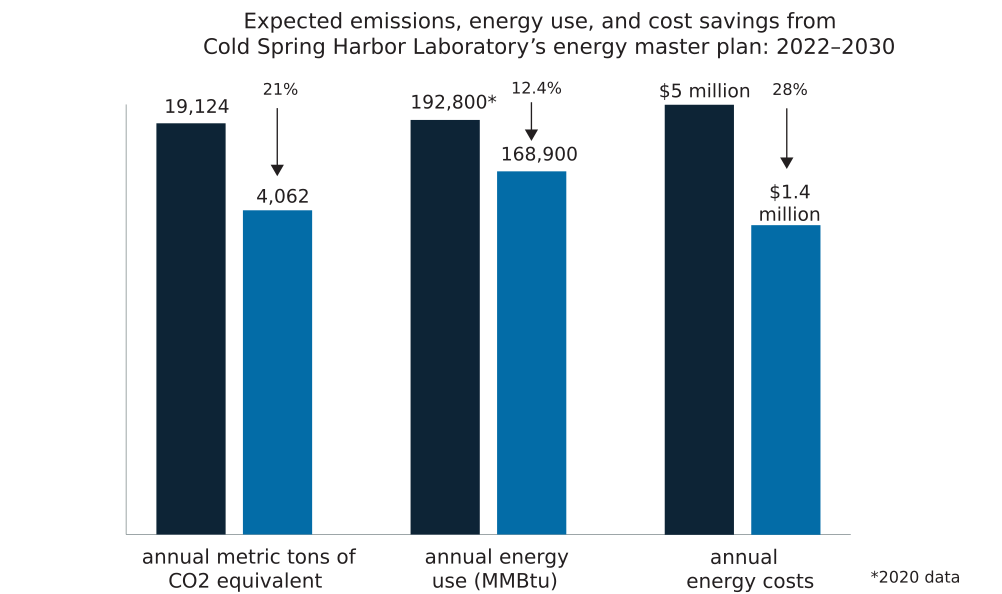
- annual metric tons of CO₂ equivalent - down 21% from 19,124 to 4,062
- annual energy use (MMBtu) - down 12.4% from 192,800 to 168,900
- annual energy costs - down 28% from $5 million to $1.4 million
Institutional Goals
Cold Spring Harbor Laboratory is aiming for a 40% reduction by 2030 against a 1990 baseline with an interim goal of 15% by 2026.
Background
Founded in 1890, Cold Spring Harbor Laboratory (CSHL) has shaped contemporary biomedical research and education with programs in cancer, neuroscience, plant biology and quantitative biology. Home to eight Nobel Prize winners, the private, not-for-profit institution employs 1,000 people including 600 scientists, students and technicians.
In 2019, CSHL received $154,000 in funding from NYSERDA through FlexTech to complete ASHRAE Level II energy audits and an energy master plan. Coupling the energy audit results with sustainability guidelines via AASHE STARS  , benchmarking against other institutions, and CSHL’s greenhouse gas emissions reduction goals, a consulting team made up by firms 5 and CHA Consulting developed an energy master plan with a detailed list of energy-conservation measures and achievable greenhouse gas emissions reductions, implementation costs, energy and cost savings, and recommended implementation sequencing.
CSHL didn’t have a dedicated energy team to drive implementation of the energy master plan once it was developed. Thus, once the plan was completed in 2022, CSHL leveraged $200,000 in funding through NYSERDA’s On-site Energy Manager program to hire a full-time energy and sustainability manager to oversee the execution of the plan.
Challenges
- With more than 60 buildings in multiple locations, and some of its main campus buildings dating to the 19th century, CSHL has strict aesthetic policies. Buildings on the laboratory grounds are listed on the National Registry of Historic Places. Thus, it’s hard to make building upgrades, and rooftop solar is unlikely.
- Distance between campus buildings also introduce additional challenges to building decarbonization, as geothermal or district geothermal are not feasible options due to costs and a lack of payback. Thus, other decarbonization options needed to be explored. That said, Schadler indicates CSHL has a water-source heat pump that can do simultaneous heating and cooling. “I’m kind of achieving a lot of what I would have wanted with geothermal in a more economical way,” he says. “But if geothermal does come back into play, we’re ready to connect.”
- Electrification on Long Island presents obstacles and limitations with the aging electric grid, resulting in decarbonization often needing to be achieved through on- or off-site renewables.
Solutions Implemented
The consultant team evaluated major mechanical and electrical systems in 20 sample buildings for energy efficiency and cost reduction improvements, identifying 173 individual energy conservation measures across campus. The measures were broken into five major categories: HVAC upgrades, building controls, lighting upgrades, plumbing and domestic hot water upgrades, and low- to no-cost measures. With an aggregated simple payback of 8.6 years, the plan identified just under $12 million in implementation costs that would result in $1.4 million in annual savings for the Laboratory.
| ECM Group | Annual Energy Savings ($) | Est. Implementation Cost ($) | Metric Tons of CO₂ Equivalent | ROI | Simple Payback (Years) |
|---|---|---|---|---|---|
| HVAC upgrades | $648,291 | $9,024,086 | 1,792.0 | 7% | 13.9 |
| Building controls | $335,554 | $864,427 | 1,189.3 | 39% | 2.6 |
| Lighting upgrades | $246,913 | $1,326,485 | 554.8 | 19% | 5.4 |
| Plumbing and DHW upgrades | $8,898 | $139,359 | 39.4 | 6% | 15.7 |
| Low- to no-cost measures | $161,614 | $643,091 | 486.4 | 25% | 4.0 |
| Total | $1,401,270 | $11,997,448 | 4,061.9 | 12% | 8.6 |
The consultant team developed a phasing plan for CSHL to implement measures recommended in the energy master plan:
| Timeline | Measures |
|---|---|
| Years 1 and 2 |
|
| Years 3 and 4 |
|
| Years 5 through 8 |
|
In addition, the consultant team recommended developing cogeneration systems for CSHL’s Hillside Campus and Woodbury Genome Center following implementation of the list of ECMs.
CSHL produced 19,124 metric tons of carbon dioxide equivalent (MTCO2e) in 2019, a baseline year chosen because pandemic operations likely increased ventilation and energy use across campus. The consultant team recommends a $500,000 annual budget to implement recommended energy-conservation measures. If CSHL moves forward with the plan as designed, they will achieve a 21% reduction in greenhouse gas emissions and a 12.4% reduction in energy use by 2030.
Timeline
- 2019—CSHL secures funding from NYSERDA and works with consultant team to perform a greenhouse gas emissions inventory, ASHRAE Level II energy audit, and an energy master plan
- 2022—CSHL secures funding from NYSERDA and hires an energy manager to oversee implementation of the energy master plan
- 2030—CSHL expects to have completed the first set of recommended energy-conservation measures in the energy master plan
Lessons Learned
- The time is now. Richard Bryant, assistant director of business operations at CSHL, recognized that state grant money was available for multiple energy- and decarbonization-related program opportunities. These grants would ultimately lead to financial payback with lower energy costs. Taking cues from a changing political and social climate, getting an energy master plan in place to take advantage of available funding and incentives with minimal financial investment from CSHL was a no-brainer.
- Implementing a plan is a full-time job. “You need a dedicated team to manage all this stuff, because I can’t do it by myself,” says Schadler. “Even with a master plan, after all the time and effort put into it, it just sits on the shelf if you don’t have a dedicated energy team.” Getting an energy manager who is working on implementation every day, Schadler says, “forces everyone’s hands to move forward” and achieve goals.
- Set realistic goals. One rule of thumb about goal setting is to follow SMART criteria: strategic, measurable, achievable, realistic, and time bound. Engaging your team and partners about setting realistic goals is key to keeping your efforts in motion—and you may even be able to enlist more support if you do.
- Communicate and celebrate your successes. Especially when it comes to cost savings, it’s helpful to showcase how an action item from a plan will lead to results. With cost savings from plan implementation, CSHL is hoping to put together a green bank to pay for more energy-savings projects.
Financing
- NYSERDA covered 50% of costs for the campus’s energy audits and energy master plan, providing $154,000 in funding through the FlexTech program.
- NYSERDA covered 75% of costs for hiring a campus energy manager, providing $200,000 in funding through the On-site Energy Manager program.
- Implementation costs for measures to be pursued are built into CSHL’s annual budget.
- CSHL is working with PSEG to explore rebates and incentives to work out a reasonable payback for decarbonization and efficiency projects.
Stakeholders Engaged
- Business Operations
- Facilities Operations
- Administration
- Sustainability Committee
For More Information
Cold Spring Harbor Laboratory
1 Bungtown Road
Cold Spring Harbor, NY 11724
Brandon King, CEM
Energy Manager, Sustainability
[email protected]
(516) 367-6870
Bruce Schadler, PE
Director of Facilities Operations
[email protected]
(516) 367-8839
Figure. — Cold Spring Harbor Laboratory’s reductions in greenhouse gas emissions, energy use, and energy costs after geothermal installations on campus
- annual metric tons of CO₂ equivalent - down 21% from 19,124 to 4,062
- annual energy use (MMBtu) - down 12.4% from 192,800 to 168,900
- annual energy costs - down 28% from $5 million to $1.4 million
Institutional Goals
Cold Spring Harbor Laboratory is aiming for a 40% reduction by 2030 against a 1990 baseline with an interim goal of 15% by 2026.
Background
Founded in 1890, Cold Spring Harbor Laboratory (CSHL) has shaped contemporary biomedical research and education with programs in cancer, neuroscience, plant biology and quantitative biology. Home to eight Nobel Prize winners, the private, not-for-profit institution employs 1,000 people including 600 scientists, students and technicians.
In 2019, CSHL received $154,000 in funding from NYSERDA through FlexTech to complete ASHRAE Level II energy audits and an energy master plan. Coupling the energy audit results with sustainability guidelines via AASHE STARS , benchmarking against other institutions, and CSHL’s greenhouse gas emissions reduction goals, a consulting team made up by firms 5 and CHA Consulting developed an energy master plan with a detailed list of energy-conservation measures and achievable greenhouse gas emissions reductions, implementation costs, energy and cost savings, and recommended implementation sequencing.
CSHL didn’t have a dedicated energy team to drive implementation of the energy master plan once it was developed. Thus, once the plan was completed in 2022, CSHL leveraged $200,000 in funding through NYSERDA’s On-site Energy Manager program to hire a full-time energy and sustainability manager to oversee the execution of the plan.
Challenges
- With more than 60 buildings in multiple locations, and some of its main campus buildings dating to the 19th century, CSHL has strict aesthetic policies. Buildings on the laboratory grounds are listed on the National Registry of Historic Places. Thus, it’s hard to make building upgrades, and rooftop solar is unlikely.
- Distance between campus buildings also introduce additional challenges to building decarbonization, as geothermal or district geothermal are not feasible options due to costs and a lack of payback. Thus, other decarbonization options needed to be explored. That said, Schadler indicates CSHL has a water-source heat pump that can do simultaneous heating and cooling. “I’m kind of achieving a lot of what I would have wanted with geothermal in a more economical way,” he says. “But if geothermal does come back into play, we’re ready to connect.”
- Electrification on Long Island presents obstacles and limitations with the aging electric grid, resulting in decarbonization often needing to be achieved through on- or off-site renewables.
Solutions Implemented
The consultant team evaluated major mechanical and electrical systems in 20 sample buildings for energy efficiency and cost reduction improvements, identifying 173 individual energy conservation measures across campus. The measures were broken into five major categories: HVAC upgrades, building controls, lighting upgrades, plumbing and domestic hot water upgrades, and low- to no-cost measures. With an aggregated simple payback of 8.6 years, the plan identified just under $12 million in implementation costs that would result in $1.4 million in annual savings for the Laboratory.
| ECM Group | Annual Energy Savings ($) | Est. Implementation Cost ($) | Metric Tons of CO₂ Equivalent | ROI | Simple Payback (Years) |
|---|---|---|---|---|---|
| HVAC upgrades | $648,291 | $9,024,086 | 1,792.0 | 7% | 13.9 |
| Building controls | $335,554 | $864,427 | 1,189.3 | 39% | 2.6 |
| Lighting upgrades | $246,913 | $1,326,485 | 554.8 | 19% | 5.4 |
| Plumbing and DHW upgrades | $8,898 | $139,359 | 39.4 | 6% | 15.7 |
| Low- to no-cost measures | $161,614 | $643,091 | 486.4 | 25% | 4.0 |
| Total | $1,401,270 | $11,997,448 | 4,061.9 | 12% | 8.6 |
The consultant team developed a phasing plan for CSHL to implement measures recommended in the energy master plan:
| Timeline | Measures |
|---|---|
| Years 1 and 2 |
|
| Years 3 and 4 |
|
| Years 5 through 8 |
|
In addition, the consultant team recommended developing cogeneration systems for CSHL’s Hillside Campus and Woodbury Genome Center following implementation of the list of ECMs.
CSHL produced 19,124 metric tons of carbon dioxide equivalent (MTCO2e) in 2019, a baseline year chosen because pandemic operations likely increased ventilation and energy use across campus. The consultant team recommends a $500,000 annual budget to implement recommended energy-conservation measures. If CSHL moves forward with the plan as designed, they will achieve a 21% reduction in greenhouse gas emissions and a 12.4% reduction in energy use by 2030.
Timeline
- 2019—CSHL secures funding from NYSERDA and works with consultant team to perform a greenhouse gas emissions inventory, ASHRAE Level II energy audit, and an energy master plan
- 2022—CSHL secures funding from NYSERDA and hires an energy manager to oversee implementation of the energy master plan
- 2030—CSHL expects to have completed the first set of recommended energy-conservation measures in the energy master plan
Lessons Learned
- The time is now. Richard Bryant, assistant director of business operations at CSHL, recognized that state grant money was available for multiple energy- and decarbonization-related program opportunities. These grants would ultimately lead to financial payback with lower energy costs. Taking cues from a changing political and social climate, getting an energy master plan in place to take advantage of available funding and incentives with minimal financial investment from CSHL was a no-brainer.
- Implementing a plan is a full-time job. “You need a dedicated team to manage all this stuff, because I can’t do it by myself,” says Schadler. “Even with a master plan, after all the time and effort put into it, it just sits on the shelf if you don’t have a dedicated energy team.” Getting an energy manager who is working on implementation every day, Schadler says, “forces everyone’s hands to move forward” and achieve goals.
- Set realistic goals. One rule of thumb about goal setting is to follow SMART criteria: strategic, measurable, achievable, realistic, and time bound. Engaging your team and partners about setting realistic goals is key to keeping your efforts in motion—and you may even be able to enlist more support if you do.
- Communicate and celebrate your successes. Especially when it comes to cost savings, it’s helpful to showcase how an action item from a plan will lead to results. With cost savings from plan implementation, CSHL is hoping to put together a green bank to pay for more energy-savings projects.
Financing
- NYSERDA covered 50% of costs for the campus’s energy audits and energy master plan, providing $154,000 in funding through the FlexTech program.
- NYSERDA covered 75% of costs for hiring a campus energy manager, providing $200,000 in funding through the On-site Energy Manager program.
- Implementation costs for measures to be pursued are built into CSHL’s annual budget.
- CSHL is working with PSEG to explore rebates and incentives to work out a reasonable payback for decarbonization and efficiency projects.
Stakeholders Engaged
- Business Operations
- Facilities Operations
- Administration
- Sustainability Committee
For More Information
Cold Spring Harbor Laboratory
1 Bungtown Road
Cold Spring Harbor, NY 11724
Brandon King, CEM
Energy Manager, Sustainability
[email protected]
(516) 367-6870
Bruce Schadler, PE
Director of Facilities Operations
[email protected]
(516) 367-8839
Connect With Us
Discover how to achieve large energy and carbon reductions across your campus. Get in touch at [email protected]