

Canajoharie Central School District
Montgomery County

With Support from NYSERDA, Canajoharie Central School District Earns Best-in-Class in Energy Management
An Upstate New York school district received funding for an energy manager with a “whole-school approach.” Working as a team, the district increased efficiency and awareness, created a pathway to net-zero heating and cooling, and received federal accolades in the process.
The CCSD energy management slogan:
Planning, implementing and recognition.
The CCSD vision: “Every Learner, Together,
World Ready”
At a Glance
Location: Montgomery County
Number of buildings in complex: 5
- "East Hill" interconnected elementary school + middle school + athletic center with pool
- High school
- Transportation facility
Total Sq ft: 349,000
Heating/Cooling in 2022
Combination of gas-fired steam boilers, gas-fired hot water boilers, forced air, unit ventilators, cabinet heaters. No central AC at the majority of East Hill complex.
NYSERDA Programs:
- Phase 1 – Energy Management: Clean Green Schools – Track I funding
- Phase 2 – Heating and Cooling: Clean Green Schools – Track II funding
- Phase 2 – Electric School Buses: New York School Bus Incentive Program (NYSBIP) funding
Phase 1 Begins
In 2022, the Canajoharie Central School District (CCSD) superintendent applied for funding to hire an on-site energy manager (OsEM) through NYSERDA’s Clean Green Schools Initiative. In early 2023, CCSD’s application was approved and they brought on Francis D’Ambrosio. Fran worked with district administration to create an energy team, an energy management plan, and to help make the necessary changes and upgrades.
First Steps: Assess Buildings
The state of the buildings was assessed first. The East Hill Complex, which houses the elementary and middle schools, had buildings and additions that dated from the 1950s, 1960s, and 1990s. The inefficient hot water and gas-fired steam boilers with components (unit ventilators) had reached the end of useful life.
“A dedicated energy manager provides focused and detailed oversight of the facilities’ ongoing energy use. I have a daily presence in the school to hear suggestions, concerns, and comments of what to fix. Everybody has something to offer in terms of flagging issues and inefficiencies.”
-Fran D’Ambrosio, Energy Manager
The high school, which was built in 2000, also had hot water boilers at the end of their useful life, and rooftop cooling units that were limping along with salvaged parts.
Additionally, the district wasn’t achieving the full estimated savings from an earlier energy performance contract. That project had addressed some “low-hanging fruit” such as LED lighting, pipe and valve insulation, and building controls.
Over eighteen months, and with the OsEM, the district developed and implemented an energy plan to modernize the energy profile of the 5-building campus and get itself on a path to a net-zero-energy future.
Benchmark, Automate, Plan
The OsEM created an energy baseline, which is a system for benchmarking energy use across all buildings. With a new digital dashboard, “ENERGY STAR® Portfolio Manager,” the OsEM was able to collect and analyze energy data, do performance comparisons, find energy inefficiencies, calculate energy use per square foot, and assess the value of future efficiency improvements.
The next steps were low- and no-cost automation and preventative maintenance programs that were quick to implement. They included:
- Adjusting set points and occupancy settings
- Deploying plug load controllers to switch off electronics after school hours
- Utilizing a work-order system and implementing an equipment maintenance program, with a goal to inventory energy-consuming equipment, track and manage repairs, and avoid costly equipment failure
A New Approach: Forming an Energy Team
Recognizing that energy efficiency and conservation would be a significant process that impacted everyone – including employees and students -- the district changed its approach to energy and formed a cross-functional Energy Team.
The team included the OsEM, the district’s superintendent, facilities director, curriculum director, principals, a bus driver, teachers, and other support staff. Together, they developed an energy plan, began to learn and teach the different clean energy technologies, and created a financial strategy for long-range projects.
Recent Work: Lights, Windows, Air Handling, Solar, Water
During 2024, the team made great progress on the energy plan. Successes included:
- Learning to control an intelligent lighting system – each of the over 3,000 lights has a controllable sensor.
- Completing a window replacement project that started in 2008.
- Replacing all East Hill roof top units for improved air handling and replacing half of the rooftop units at the high school. Some new units are energy recovery units, which added efficiency and savings.
- Completing the contracting phase and entering the construction phase of a 700-kilowatt solar array, which has a go-live date in early 2026. The array is expected to offset approximately 80% of the district’s electricity costs through an energy performance contract (EPC). The benefit of an EPC is that it enables energy generated by solar to offset construction costs and produces an excess that provides savings.
- Tracking water use to identify and rectify leaks to promote conservation and reduce waste.
- Switching their energy supplier to take advantage of remote renewable credits. This is a zero-cost opportunity available through certain utilities and regions. Remote renewable credits are a way to receive credits on electric bills for solar energy generated elsewhere.
Savings Snapshot 2022-24
As energy awareness at the school increased, so did savings; in just one year, CCSD recognized an 8% reduction in energy expenditures.
Average Energy Use (Feb 2022)
- 32,628 therms natural gas
- 145,000 kWh electric
- Energy cost: $31,245
Average Energy Use (Feb 2024)
- 26,759 therms
- 121,000 kWh
- Energy cost: $28,570
As of late 2024, the district has measured a 13% energy cost savings compared to 2022.
Benefits for Students
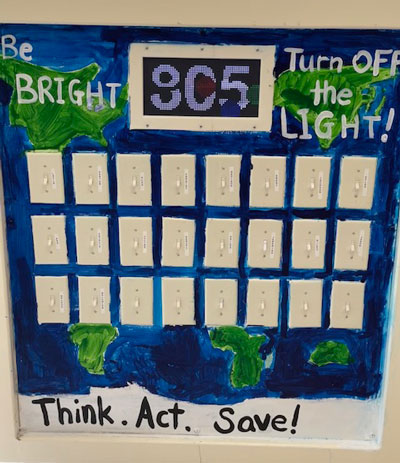
Switch buddy reminds kids to turn off lights and save energy.
Source: CCSD
The district has introduced energy education into its curriculum across all grade levels.
Elementary School
- The energy manager engages students on the basics of energy conservation.
- To reinforce good habits, there is a “switch buddy,” or an interactive machine with 24 light switches that students are responsible for turning off before leaving the classroom. Students painted the device to give them a stake in the program and promote awareness.
Middle School
- Exploration of the science and real-world applications of energy.
- Hands-on experiments, such as temperature testing different light bulb types to assess their efficiency. “Understanding that we want light, rather than heat, the students instantly realize what energy efficiency means,” says Fran. Students took a field trip to New York Energy Zone
 in Utica to learn about New York’s history and future of electricity.
High School
- Exposure to renewable energy systems and energy-related career opportunities with visits to SUNY Morrisville. Morrisville has two- and four-year renewable energy degree programs. They also visited the Fenner Renewable Energy Education Center for a real-world look at clean energy jobs.
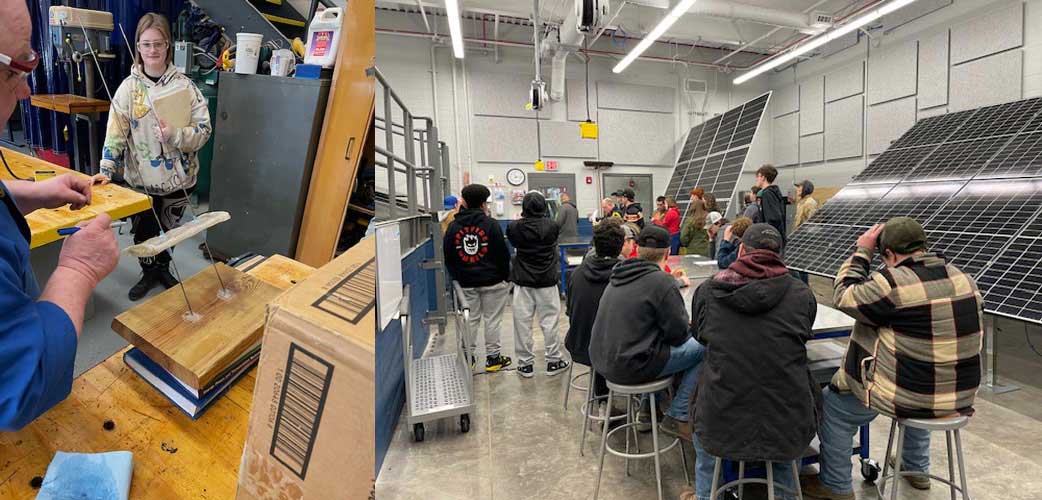
Students learn about energy and cleantech. Source: CCSD
All-School Engagement Benefits Everyone
“Due to the support and resources from NYSERDA and the meticulous management that Fran employs as energy manager, the district has been able to move forward with innovative and future-driven energy management programs and initiatives that will position us for the future, not only financially, but in terms of environmental resilience as it pertains to our facilities.”
-Dr. Nick Fitzgerald, Superintendent of Schools at Canajoharie CSD
In a short amount of time, the CCSD has made significant strides reducing the district’s energy consumption. With the support of the Superintendent and Board of Education (a crucial aspect), the school has a comprehensive energy management plan. Each building has been through an energy analysis, including a review of windows and insulation. Energy use is tracked and reported monthly, quarterly, and yearly, highlighting areas for improvement.
Preparing for Phase 2
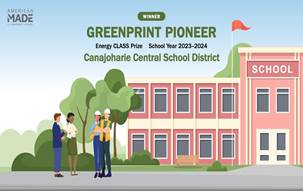
CCSD received federal recognition for its
commitment to better energy management.
The district’s Energy Team plans to further reduce reliance on fossil fuels (natural gas, diesel, gasoline) with solar, heat pumps, battery storage, and with an electrification plan for its school buses. Looking ahead, the energy manager is focused on Phase 2 actions such as reducing or eliminating natural gas and replacing it with electricity across the district and will continue to apply for grants to help the district decarbonize their buildings
The CCSD proves that a dedicated energy manager and a shift to all-school engagement can benefit everyone.
Recognition: CCSD was 1 of 13 honorees to receive Efficient and Healthy Schools Recognition from The U.S. Department of Energy for 2023-2024. More specifically, the district was recognized as a “Best in Class Solutions Strategist” for its energy management plan, which includes well-planned and replicable building energy efficiency improvements and student education opportunities.
Summer 2025 Update: CCSD Moves Ahead with Phase 2 Upgrades
Summer 2025 has been busy for CCSD. With guidance from the OsEM, with recent board approvals, and with a new round of funding announcements, CCSD is laying the groundwork for its Phase 2 energy upgrades.
Those upgrades, which will occur across 2025-2027, include:
- Developing a fleet electrification and charging plan, transitioning to zero-emissions electric school buses (ESBs). The first ESB was delivered August 2025, with funding from NYSERDA’s New York School Bus Incentive Program [NYSBIP].
- Installing a clean HVAC system that combines geothermal and air source heat pumps for heating and adds cooling for resilience. In May 2025, a heat pump system for the East Hill Complex was put up for a vote and approved by the community. With funding from NYSERDA’s P-12 Clean Green Schools [Track II], a combined geothermal and air source heat pump system will be installed.
- The addition of a rooftop solar system to this phase will offset the electrical costs to operate the new “clean” geothermal and air source heat pump systems for a net zero energy upgrade that adds much needed cooling to the circa 1951 East Hill Complex.
An additional benefit to students includes a glass hallway that will enable them to see the ground source heat pump system (geothermal). Components will be color coded so students can see and understand how it works.