

South Colonie Central School District
Albany County

South Colonie Central School District: A People-Powered Energy Transformation
With help from NYSERDA, a multi-building P-12 campus learns about energy efficiency then leverages staff and student engagement for big savings.
The South Colonie Central School District, located in the Capital Region, serves approximately 4,800 students. The district has five elementary schools, two middle schools, and a high school. Faced with rising utility costs and aging infrastructure, the District took bold steps to improve energy efficiency across its 10-building campus.
With the support of NYSERDA, the district brought on an on-site energy manager (OsEM). The goal was to embark on a multi-year initiative to:
- reduce electricity and natural gas use
- reduce water consumption
- make operational improvements
- perform low-cost upgrades
- engage staff and students
An Audit Identifies Energy Use/Savings
Audits revealed lights left on overnight, outdated fixtures, continuously running HVAC systems, and underused appliances that were silently draining power and resources.
The OsEM made recommendations to address these issues. Then, a list of no- and low-cost action items was developed, which included:
- intelligent scheduling
- strategic upgrades
- lighting and water conservation
- staff & student engagement
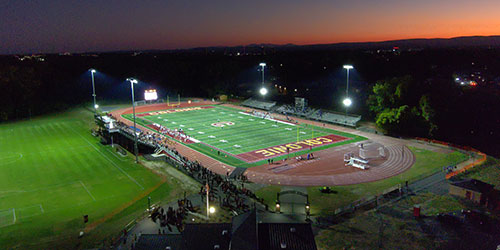
Aerial view of South Colonie’s stadium.
Project at a Glance
Location: Albany County
Enrollment: P-12, approximately 4,800 students
Objective: Understand energy use, implement energy management program
NYSERDA Program: On-site Energy Manager
An Audit Leads to Solutions
With engagement from staff and students, the district took these actions:
Lighting
- Replaced 70 failed fixtures across 8 schools with LEDs.
- Launched a phased plug-and-play LED bulb program.
- Swapped outdoor sodium lights for modern equivalents, and unused poles were removed.
- Made display case lighting adjustments (across 10+ cases), which led to an estimated 460 kWh in annual savings by switching off lights at night.
- Savings from reduced hallway and library lighting schedules totaled 3,540 kWh and $560 annually.
Water
- Leaks in locker rooms were fixed—one using a custom 3D-printed adapter.
- Meter corrections in two schools – replaced oversize water (one-time meter replacement cost of $7,800), which saved the district 1.8 million gallons of water and $35,000 annually.
Computer shutdown optimization
- Earlier nightly power-downs, from 11:30 p.m. to 9:30 p.m.
- Manual shutdown assignments in elementary schools.
Unoccupied hours
- Hot water circulators and HVAC units previously running during unoccupied hours are now manually controlled, reducing after-hours usage.
Internship & Eco Club
- A 54-hour student internship and Eco Club engagement.
- Tied conservation efforts to student learning and career exposure.
- New staff were onboarded with energy-saving protocols.
Can You Hear the Electricity?
During a quick walkthrough of our buildings, a colleague mentioned a leaky faucet. I told him a work order had been submitted, and he said, ‘You have no idea the anxiety it gives me to walk out of that bathroom and not be able to turn off the faucet.’ It made me think—imagine how much electricity we could save if people could ‘hear’ it running the same way they hear water.
Most people wouldn’t leave water running because they can see and hear it, but with electricity, that’s not the case. Part of my job is helping staff and students understand that leaving lights or other appliances on when they’re not in use is essentially ‘water down the drain.’
The good news is that shortly after reporting the leak, our facilities team fixed it, preventing waste. I try to help people make similar connections with energy by translating kilowatts and therms into something everyone can understand. When I point out that our district utility bill is over $3,000 every day, it really gets people’s attention.
– Jim Brown, Energy Manager
Strategies for Success
People-first approach: Custodians, administrators, and teachers were often engaged early. Training walkthroughs, labeled breakers, and practical handoff of responsibilities gave staff absolute ownership of energy-saving practices.
Audit-driven strategy: Consistent building audits helped uncover dozens of overlooked issues—from an unplugged water fountain compressor still drawing power, to exterior lights controlled from unrelated switches.
Creative problem-solving: When off-the-shelf solutions weren’t available, the OsEM used tools like 3D printing to temporarily stop leaks, allowing for fast action and long-term planning.
Cost-effective wins: The district avoided large capital expenditures by focusing on behavior changes, simple equipment tweaks, and strategic scheduling — proving that small actions compound into significant impact.
Student involvement: Engaging youth through real-world internships and classroom presentations helped extend the program’s reach and build a sustainability culture for the future.
Simple steps like turning off or unplugging items such as refrigerators, microwaves, and other electronics when they’re not in use can go a long way. It’s about building small habits that add up over time, saving resources and lowering costs while teaching our staff and students the importance of sustainability. Over school breaks, our facilities team also makes a point to check and unplug equipment if it’s been overlooked, ensuring we maximize every opportunity to conserve energy.
– Daniel Grizzel, Assistant Director of Facilities
Insights and Lessons Learned
Over three years, and with behavioral interventions, low-cost hardware changes, and deep engagement with staff and students, the district achieved over $35,000 in annual savings and reduced water usage by 1.8 million gallons, with an additional $241,787 in potential energy savings measures identified.
The South Colonie Central School District’s energy management program serves as a scalable blueprint for other school systems that want to reduce costs, conserve resources, and promote a culture of energy stewardship.
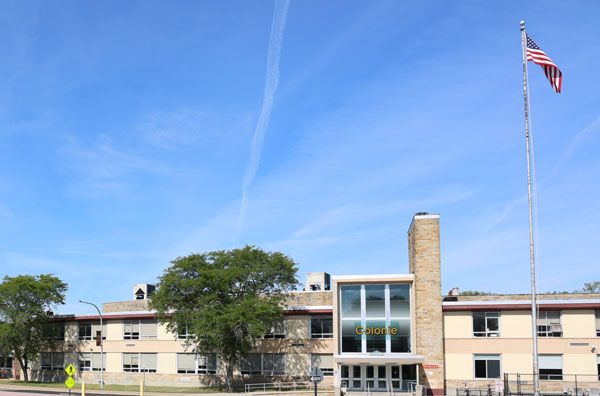
Colonie Central High School
Ready to learn more?
If your school would like to participate, explore the On-Site Energy Manager Program or contact us at [email protected].