

Pace University
New York County

Moving Away From Steam: Pace University and the Renovation of One Pace Plaza
An energy-intensive building complex in downtown Manhattan relied on steam-absorption chillers for cooling. Local Law 97 forced a conversation to rethink its reliance on district steam. Bundled with a gut renovation project, a new 700-ton heat pump plant serving a 560,000-square-foot building for cooling needs and energy-efficiency system upgrades will reduce steam use by about 75% and reduce emissions by 61%.
Campus Characteristics
- Location: Manhattan and Pleasantville, New York
- Founding year: 1906
- Total enrollment: 14,092
- Campus size: 218 acres
- Institution type: private
- Highest degree: doctoral
Key Metrics

- $2.8 million annual energy costs in 2024
- $500,000 LL97 non-compliance fine
- $10.5 million for energy retrofit portion of $218 million renovation costs

- 700-ton heat pump plant
- LED lighting
- Insulation
- Heat recovery
- VAV units
- VFD
- Renewable energy certificates (RECs) until off-site purchasing agreement can be secured

- Steam use reduction by 80–90%
- 61% emissions reduction
Institutional Goals
Pace University set a goal through the U.S. Department of Energy’s Better Climate Challenge to become net-zero by 2040, with a midpoint of reducing greenhouse gas emissions 50% by 2030 against a 2017 baseline.
Figure 1 - One Pace Plaza’s emissions performance compared to Local Law 97 targets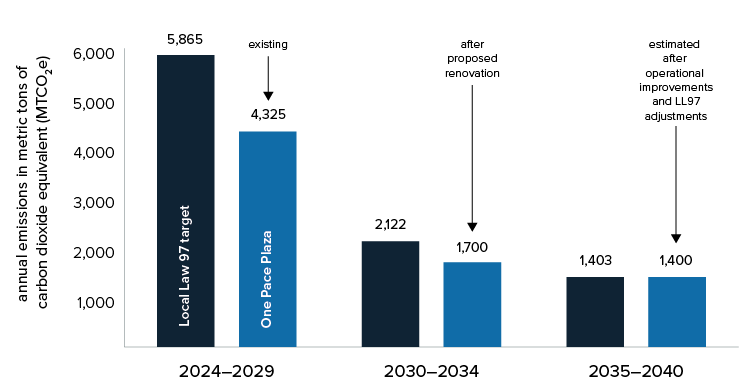
Background
One Pace Plaza, built between 1968–1970, is the flagship building complex of Pace University. Located in Lower Manhattan and constructed as part of the Brooklyn Bridge Title I Project, the plaza consists of two buildings connected by a courtyard that, before renovations began, housed multiple campus functions, including the library, cafeteria, Schimmel Theater, student health center, lab space, classrooms, gym, and student residence hall rooms.
Pace University’s heating and cooling is mainly provided by Con Edison’s commercial steam service. Insulation was not part of the buildings’ original construction. Many air handlers and ductwork are original to the building. During the 1990s, steam absorption chillers were installed. Additionally, the building’s reliance on steam extends to steam-to-hot-water conversion, direct steam heating, and steam-heated domestic hot water.
One Pace Plaza was the University’s highest energy user, with an energy use intensity (EUI) of 122.4 kBtu/sf—significantly higher than most other Pace campus buildings.
Pace’s steam system was also operating inefficiently. The old steam system returns 180-degree condensate water after the steam has circulated through the building, a temperature only needed for heating the buildings on the coldest days of the year. Without a heat recovery system, Pace University lost out on the opportunity to recirculate this heat and instead held the scalding condensate water in a pit to cool off before it could be released to the sewer line.
—Ryan McEnany, Director of Energy & Resiliency, Pace University
When Local Law 97 was passed into law in 2019, the West Side of One Pace Plaza had just undergone a partial renovation that transformed the lower portion of the building. Additionally, plans were already in development to renovate floors 4, 5, and 6, with new, more efficient rooftop units being installed as HVAC for this space. But the new equipment remained reliant on steam. Pace’s Director of Energy & Resiliency Ryan McEnany recognized the fines associated with non-compliance would amount to $500,000 annually, a key factor in ensuring that the current plans to renovate One Pace Plaza East would require more careful consideration of decarbonization options.
Funding and Financing
In 2023, NYSERDA selected One Pace Plaza to be one of fifteen participants in the Commercial and Industrial (C&I) Carbon Challenge, an initiative aimed at providing large, non-residential energy users resources to achieve deep decarbonization while revitalizing historically marginalized communities. Pace was awarded nearly $1.5 million through this fund in November 2023.
In addition, as this is a gut renovation of several major portions of One Pace Plaza East, the University has sought funding through the University’s construction fund, issued debts, fundraising, federal appropriations, and a $25 million commitment from New York State for including the Performing Arts Center. In total, the project is budgeted at $218 million, $10.5 million of which (4.8%) is committed directly toward energy efficiency and decarbonization.
Solutions Explored
To stay within budget, Pace’s facilities team faced a choice between building insulation or windows replacement. Following an analysis wherein it was determined that insulation would be $858,000 vs. windows at $7 million, Pace opted for insulation, as windows could be replaced at a later date. Interestingly enough, the insulation provided greater energy savings.
Pace issued a request for proposals (RFP) for design engineers to develop new HVAC solutions for One Pace Plaza East. By including compliance with Local Law 97 as a design requirement, the top engineering firms that were ultimately under consideration understood the need to push towards decarbonization. They soon learned of the multiphasic aspects of this work and that a full decarbonization would not be achievable now, but that solutions needed to anticipate this eventuality.
Key to this transition is eliminating the use of steam to cool buildings. While steam would not be eliminated entirely—newer equipment that uses steam for heating was just installed at One Pace Plaza West in 2021—it would no longer be used to run absorption chillers. Air-cooled heat pumps were also explored for Maria’s Tower (a residence hall), but space constraints limited that option.
Solutions Chosen
Ultimately, the solution proposed, developed by engineering firm Kohler Ronan  , was to install a 700-ton modular heat pump plant with console water-source heat pump units that will go in the residence hall (Maria’s Tower). Additional energy-saving solutions were the installation of insulation, high-efficiency variable air volume (VAV) units and variable frequency drives (VFDs), heat recovery, and lighting upgrades that will exceed New York City’s power density code by 15%. The renovation is expected to achieve LEED® Gold ID&C and a WELL Building Standard.
—Ryan McEnany, Director of Energy & Resiliency, Pace University
Addressing climate control during the shoulder seasons, when parts of buildings can be cooler or warmer than other parts, is an added benefit to the heat pump plant.
“One of the best parts about the heat pump plant producing chilled water is that in a time like late October, the plant will be providing both chilled and hot water on demand,” McEnany said.
Figure 2 - One Pace Plaza: the switch to electrified cooling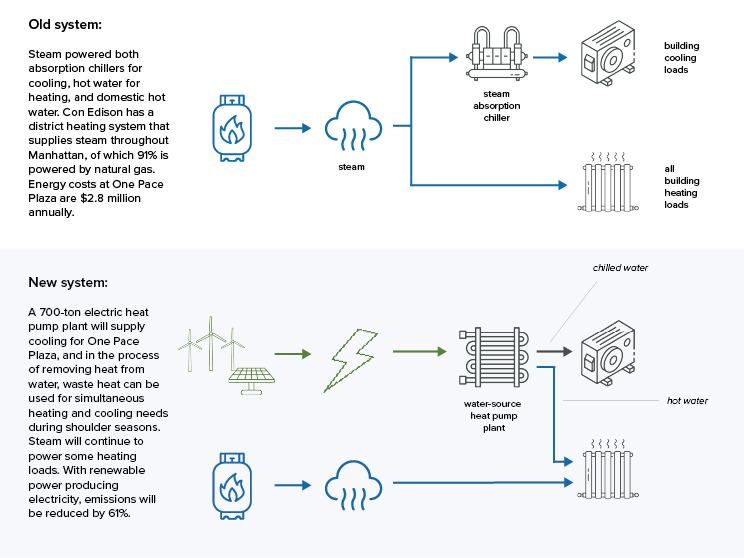
Timeline
- Summer 2024—demolition of all interiors underway
- Spring 2025—installation of new 700-ton heat pump plant, insulation, HVAC equipment installation
- Spring 2026—project completion date
Lessons Learned
- Decarbonization can be a chess game. In 2021, Pace installed new rooftop HVAC units directly connected to the steam system as part of their One Pace Plaza West renovation project, prior to serious discussions about decarbonization. In the future, these will need to be replaced to decarbonize fully. But getting 75% of the way now is important, as future equipment replacements with planned maintenance will get Pace the rest of the way. In short, when considering today’s decisions, think about designing well into the future.
- Hot happens. Plan for back-up. Maria’s Tower, the residence hall, has three relatively new (less than ten-year-old) 90-ton chiller units that are still operating during demolition. Under ordinary circumstances, these three chiller units were determined to be more than adequate to provide air conditioning during peak summer heat—and thus renting a chiller was deemed unnecessary. But one unit failed, requiring repairs. Thanks to manufacturing delays, repairs were unable to happen in time for some of the hottest days of the summer, leading to complaints from building occupants with only two-thirds of chiller capacity operational. The upshot: plan for back-up.
- Education on the total picture is crucial. McEnany doesn’t believe the project would have been as successful in reducing emissions, nor would the University have been as heavily invested in the heat pump plant, had the institution not already understood and prioritized the need to decarbonize. A shared understanding of the complexity of the situation was critical for implementing a relatively complex solution. This message came not just from the sustainability and energy department, but from facilities maintenance personnel, New York City governmental agencies, equipment vendors, law firms that could emphasize the implications of Local Law 97, and others. Most critically, says McEnany, was the Capital Planning and Facilities’ vice presidents understanding of the serious potential fines and commitment to reducing greenhouse gas emissions that ultimately led to design specifications meeting Local Law 97 requirements.
- Trust is not achieved in a day. Building trust with a diverse set of stakeholders does not happen in one meeting or even a week or a month. Most important was project managers providing valuable feedback and information when approached by internal departments seeking an honest take.
- Internal—and external—stakeholders need to be on the same page. Consistent, straightforward communication with internal stakeholders, from capital planning and administration to faculty and students, throughout both the conceptual and the construction phases of a project, helps keep everyone on board with a project throughout the process. But external stakeholders such as architects, engineers, and construction firms need to be engaged throughout the design process, as it is important they understand and support institutional sustainability and decarbonization goals.
Stakeholders Engaged
Internal
- Campus Planning and Facilities
- Executive Administration
- Finance
- IT
- Performing Arts Department
- Residence Life Department
- Students
- Faculty
External
- Owner’s representative
- Architectural firm
- Design engineer
- Construction management
For More Information
Pace University
One Pace Plaza
New York, NY 10038
Ryan McEnany
Director of Energy and Resiliency
[email protected]
914-923-2641
Institutional Goals
Pace University set a goal through the U.S. Department of Energy’s Better Climate Challenge to become net-zero by 2040, with a midpoint of reducing greenhouse gas emissions 50% by 2030 against a 2017 baseline.
Figure 1 - One Pace Plaza’s emissions performance compared to Local Law 97 targets
Background
One Pace Plaza, built between 1968–1970, is the flagship building complex of Pace University. Located in Lower Manhattan and constructed as part of the Brooklyn Bridge Title I Project, the plaza consists of two buildings connected by a courtyard that, before renovations began, housed multiple campus functions, including the library, cafeteria, Schimmel Theater, student health center, lab space, classrooms, gym, and student residence hall rooms.
Pace University’s heating and cooling is mainly provided by Con Edison’s commercial steam service. Insulation was not part of the buildings’ original construction. Many air handlers and ductwork are original to the building. During the 1990s, steam absorption chillers were installed. Additionally, the building’s reliance on steam extends to steam-to-hot-water conversion, direct steam heating, and steam-heated domestic hot water.
One Pace Plaza was the University’s highest energy user, with an energy use intensity (EUI) of 122.4 kBtu/sf—significantly higher than most other Pace campus buildings.
Pace’s steam system was also operating inefficiently. The old steam system returns 180-degree condensate water after the steam has circulated through the building, a temperature only needed for heating the buildings on the coldest days of the year. Without a heat recovery system, Pace University lost out on the opportunity to recirculate this heat and instead held the scalding condensate water in a pit to cool off before it could be released to the sewer line.
—Ryan McEnany, Director of Energy & Resiliency, Pace University
When Local Law 97 was passed into law in 2019, the West Side of One Pace Plaza had just undergone a partial renovation that transformed the lower portion of the building. Additionally, plans were already in development to renovate floors 4, 5, and 6, with new, more efficient rooftop units being installed as HVAC for this space. But the new equipment remained reliant on steam. Pace’s Director of Energy & Resiliency Ryan McEnany recognized the fines associated with non-compliance would amount to $500,000 annually, a key factor in ensuring that the current plans to renovate One Pace Plaza East would require more careful consideration of decarbonization options.
Funding and Financing
In 2023, NYSERDA selected One Pace Plaza to be one of fifteen participants in the Commercial and Industrial (C&I) Carbon Challenge, an initiative aimed at providing large, non-residential energy users resources to achieve deep decarbonization while revitalizing historically marginalized communities. Pace was awarded nearly $1.5 million through this fund in November 2023.
In addition, as this is a gut renovation of several major portions of One Pace Plaza East, the University has sought funding through the University’s construction fund, issued debts, fundraising, federal appropriations, and a $25 million commitment from New York State for including the Performing Arts Center. In total, the project is budgeted at $218 million, $10.5 million of which (4.8%) is committed directly toward energy efficiency and decarbonization.
Solutions Explored
To stay within budget, Pace’s facilities team faced a choice between building insulation or windows replacement. Following an analysis wherein it was determined that insulation would be $858,000 vs. windows at $7 million, Pace opted for insulation, as windows could be replaced at a later date. Interestingly enough, the insulation provided greater energy savings.
Pace issued a request for proposals (RFP) for design engineers to develop new HVAC solutions for One Pace Plaza East. By including compliance with Local Law 97 as a design requirement, the top engineering firms that were ultimately under consideration understood the need to push towards decarbonization. They soon learned of the multiphasic aspects of this work and that a full decarbonization would not be achievable now, but that solutions needed to anticipate this eventuality.
Key to this transition is eliminating the use of steam to cool buildings. While steam would not be eliminated entirely—newer equipment that uses steam for heating was just installed at One Pace Plaza West in 2021—it would no longer be used to run absorption chillers. Air-cooled heat pumps were also explored for Maria’s Tower (a residence hall), but space constraints limited that option.
Solutions Chosen
Ultimately, the solution proposed, developed by engineering firm Kohler Ronan , was to install a 700-ton modular heat pump plant with console water-source heat pump units that will go in the residence hall (Maria’s Tower). Additional energy-saving solutions were the installation of insulation, high-efficiency variable air volume (VAV) units and variable frequency drives (VFDs), heat recovery, and lighting upgrades that will exceed New York City’s power density code by 15%. The renovation is expected to achieve LEED® Gold ID&C and a WELL Building Standard.
—Ryan McEnany, Director of Energy & Resiliency, Pace University
Addressing climate control during the shoulder seasons, when parts of buildings can be cooler or warmer than other parts, is an added benefit to the heat pump plant.
“One of the best parts about the heat pump plant producing chilled water is that in a time like late October, the plant will be providing both chilled and hot water on demand,” McEnany said.
Figure 2 - One Pace Plaza: the switch to electrified cooling
Timeline
- Summer 2024—demolition of all interiors underway
- Spring 2025—installation of new 700-ton heat pump plant, insulation, HVAC equipment installation
- Spring 2026—project completion date
Lessons Learned
- Decarbonization can be a chess game. In 2021, Pace installed new rooftop HVAC units directly connected to the steam system as part of their One Pace Plaza West renovation project, prior to serious discussions about decarbonization. In the future, these will need to be replaced to decarbonize fully. But getting 75% of the way now is important, as future equipment replacements with planned maintenance will get Pace the rest of the way. In short, when considering today’s decisions, think about designing well into the future.
- Hot happens. Plan for back-up. Maria’s Tower, the residence hall, has three relatively new (less than ten-year-old) 90-ton chiller units that are still operating during demolition. Under ordinary circumstances, these three chiller units were determined to be more than adequate to provide air conditioning during peak summer heat—and thus renting a chiller was deemed unnecessary. But one unit failed, requiring repairs. Thanks to manufacturing delays, repairs were unable to happen in time for some of the hottest days of the summer, leading to complaints from building occupants with only two-thirds of chiller capacity operational. The upshot: plan for back-up.
- Education on the total picture is crucial. McEnany doesn’t believe the project would have been as successful in reducing emissions, nor would the University have been as heavily invested in the heat pump plant, had the institution not already understood and prioritized the need to decarbonize. A shared understanding of the complexity of the situation was critical for implementing a relatively complex solution. This message came not just from the sustainability and energy department, but from facilities maintenance personnel, New York City governmental agencies, equipment vendors, law firms that could emphasize the implications of Local Law 97, and others. Most critically, says McEnany, was the Capital Planning and Facilities’ vice presidents understanding of the serious potential fines and commitment to reducing greenhouse gas emissions that ultimately led to design specifications meeting Local Law 97 requirements.
- Trust is not achieved in a day. Building trust with a diverse set of stakeholders does not happen in one meeting or even a week or a month. Most important was project managers providing valuable feedback and information when approached by internal departments seeking an honest take.
- Internal—and external—stakeholders need to be on the same page. Consistent, straightforward communication with internal stakeholders, from capital planning and administration to faculty and students, throughout both the conceptual and the construction phases of a project, helps keep everyone on board with a project throughout the process. But external stakeholders such as architects, engineers, and construction firms need to be engaged throughout the design process, as it is important they understand and support institutional sustainability and decarbonization goals.
Stakeholders Engaged
Internal
- Campus Planning and Facilities
- Executive Administration
- Finance
- IT
- Performing Arts Department
- Residence Life Department
- Students
- Faculty
External
- Owner’s representative
- Architectural firm
- Design engineer
- Construction management
For More Information
Pace University
One Pace Plaza
New York, NY 10038
Ryan McEnany
Director of Energy and Resiliency
[email protected]
914-923-2641
Connect With Us
Discover how to achieve large energy and carbon reductions across your campus. Get in touch at [email protected]