

Erie County Wastewater Facilities
Erie County

Filtering out excess energy use at the Erie County DSM
Overview
The Erie County Division of Sewerage Management (DSM) has always valued efficiency. Established in the 1960s, the DSM’s mission is to provide cost-effective, customer-oriented wastewater service that protects public health and enhances the natural environment. This is accomplished through the operation and maintenance of six wastewater treatment facilities, just under 100 pumping stations, five overflow retention facilities, and over 1,000 miles of gravity sewer pipe and force mains.
Project Spotlight
Company Name:
Erie County Wastewater Facilities
Business Type:
Wastewater Management
Location:
Erie County, NY
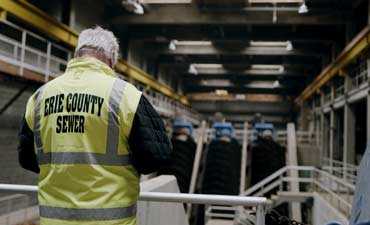
The largest of the DSM’s wastewater treatment plants is the Southtown’s Advanced Wastewater Treatment Facility. Electricity accounts for 9% of total expenditures at the Southtown treatment plant and is similarly high at the DSM’s other wastewater facilities.
“Energy is a big cost for our utility—and that energy is needed to power our pumps and other equipment that are critical to protect the environment and protect water quality. But also, there’s other environmental aspects that we must consider: we also have to look at our carbon footprint.” – Joe Fiegl, Deputy Commissioner of Erie County’s Department of Environmental Planning
“What’s great about strategic energy management —it’s really a more holistic look, and it has brought energy into the consciousness of our staff, so we’re always looking at these low-cost, no-cost opportunities.”
—Joe Fiegl, Deputy Commissioner of Erie County’s Department of Environmental Planning
Accelerated Energy and Cost-savings Across the Board
DSM has uncovered, analyzed, and prioritized energy optimization opportunities that can be addressed strategically as part of everyday operations. This continuous, integrated approach is what makes SEM so powerful.
SEM allows organizations to identify and solve for the little things—the daily processes that are so routine they become almost invisible over time. It also helps facilities take a cross-sectional view of their processes, involving people from every area of the organization who might not otherwise communicate, let alone collaborate. “I thought we were doing a good job before, but there were things we weren’t even looking at.” – Joe Fiegl