

Newfield Central School District
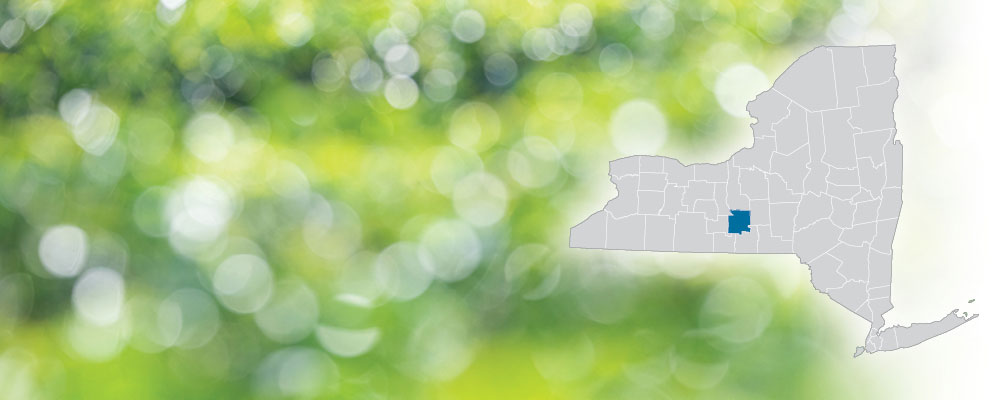
Tompkins County
Newfield Central School District Describes How It Electrified its Fleet in a Rural Region
Newfield Central School District (NCSD) is a small, rural school district in central New York State about 5 miles southwest of Ithaca. Each day, its fleet picks up about 550 students and covers approximately 1,050 miles.
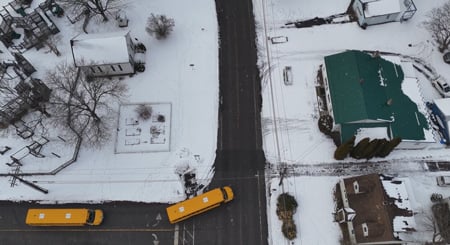
Newfield’s electric buses head out on a winter run.
Project at a Glance
Location: Southwest of Ithaca
Grade: K-12
Number of students: about 630
Total vehicles in fleet: 13 buses and 3 vans
Electric buses: 3 today, plans to electrify entire fleet
Number of chargers: 4 installed, 18 at full build-out
Support: New York School Bus Incentive Program (NYSERDA) and Clean School Bus Program (EPA)
Timeline: 2020-2024 for first bus, full electrification by 2035
In 2020, NCSD decided to begin the process of converting from diesel to electric buses. In 2024, NCSD put its first electric school buses (ESBs) on the road.
NYSERDA was recently in touch with District Superintendent, Eric Hartz, and Business Administrator, Perry Gorgen, to find out about their experience. Here’s a look at how they navigated the steps of the conversion process.
1. Perception and Budgeting
The district worked with the community for budget approval. During the 2022 budget process, conversations were held at public board meetings to inform the public and a vote was passed in May 2022 to acquire three vehicles with EPA funding.
2. Charging Infrastructure
Designing and building charging infrastructure required time and planning, as well as working with utilities, certified electricians, and others.
As part of the EPA Clean School Bus grant, a study was done to evaluate the district’s electrical infrastructure and its capacity to meet the new demand from electric vehicles. That study formed the basis for NCSD’s team of architects and engineers (King + King from Syracuse, NY) to work with its local utility (NYSEG) on meeting future needs.
During the design process, a decision was made to fully build out charging infrastructure, with transformer, panel, and connections to accommodate as many as 18 chargers. Four of 18 chargers have been installed to date.
3. Staff Training and Maintenance
District drivers and mechanics all needed education about ESBs and charging. At NCSD, driver and mechanic education has been an ongoing part of ESB adoption.
Initial training was provided through the bus dealer, Matthews, with some early adopters among the drivers operating the electric buses since Fall 2024. Now, in-house trainers provide hands-on training to new drivers.
Mechanics also have training through Matthews, and they work with the Matthews team to assess any issues and get repairs done under warranty.
4. Data Collection and Transparency
For greater transparency with the community, NCSD shares data on charger/bus performance on the district website at school board meetings, and in newsletters.
| EV number | Trip date | Time Out | Temp °F | Starting Charge | Starting Miles | Ending Charge | Ending Miles |
|---|---|---|---|---|---|---|---|
| E2 | 4/11/25 | 1:47 PM | 42 | 96% | 4,718 | 54% | 4718.4 |
| E4 | 4/11/25 | 6:00 AM | 29 | 96% | 4,606 | 46% | 4606.4 |
| E4 | 4/10/25 | 1:37 PM | 40 | 91% | 4,651 | 71% | 4674 |
| E4 | 4/9/25 | 6:40 AM | 23 | 98% | 2,389 | 62% | 2431 |
5. Using ESBs
ESBs are used for daily AM and PM routes to and from school. An ESB has been put on the longest route, running about 45 miles in the morning, which takes around 50-60% of the charge, depending on the temperature.
It then has about 4-4.5 hours to charge, which typically brings it back up to 95% charge or more, giving it the ability to go back out for the 45-mile afternoon run. The district reports it has consistently operated on this schedule, even in below-zero weather. It did report one exception on a day with a 2-hour school opening delay due to -8 degree weather. The delay shortened the mid-day charge time.
6. District Benefits
Benefits the district reported:
- Compared to diesel buses, kids, drivers, and bus attendants all prefer the experience of the ESB. The primary reason, though, is that the bus is so much quieter. The quiet helps keep kids calm and helps drivers and bus attendants do their jobs of keeping kids safe. The quieter ride improves student behavior on the bus as well as driver/attendant interventions. There are fuel savings compared to diesel as well.
- NCSD came across a surprise benefit with their chargers; they double as powerful diagnostic computers that offer valuable data on the bus connected to it. Diagnostics may point out potential mechanical issues sooner rather than later.
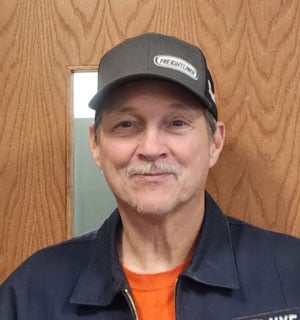

“I like it – all my kids like riding on the electric bus, and I prefer driving it. It has a tiny bit less power than the diesel, but it’s a lot quieter, and it heats better. It has different gauges, and you do have to get used to them. It’s a smoother ride, and I think it has better traction than the diesel in the winter because the weight of the batteries is distributed instead of all up front.”
– Bryon Hunter, Driver“Even with the lowest cost for diesel fuel that you could hope for, electric is still one-third the fuel price.”
– Perry Gorgen, Business Administrator7. Future Planning
The district’s current vehicle replacement plan calls for replacing vehicles at around 8-10 years of service. On this schedule, the district will be replacing 1-2 vehicles a year and is currently on track to meet the requirement to be fully electric by 2035.
| EPA Incentive | NYSBIP Incentive | NYSEG (utility Incentive) | District Expenses | Total | |
|---|---|---|---|---|---|
| Infrastructure (4 initial chargers plus utility upgrade costs to prepare for 18 chargers at full build out) | $42,552 | $112,772 | $3,851 | $190,092 | $345,416 |
| 3 Type C buses | $1,125,000 | $100,352 | $0 | $7,000 | $1,232,352 |
| 1 Type C bus arriving FY26 | $0 | $257,250 | $0 | $198,059 | $455,309 |
| Totals | $1,167,552 | $470,374 | $3,851 | $395,152 | $2,033,077 |
8. Lessons Learned/ Tips for Others
NCSD shared these tips:
- Start early and give yourself enough time to thoughtfully map out funding and infrastructure/utility upgrades. This is very important. It may include frontloading your initial utility/infrastructure upgrades, which helps expedite subsequent ESB/charger purchases and enable economies of scale.
- Take advantage of all the available funding resources. This can include NYSERDA funds, utility incentives, and state aid.
- There may be unexpected connectivity issues with chargers. NCSD initially had its chargers connected using Wi-Fi, but this was spotty and caused connectivity issues. The district determined it needed to hardwire these chargers for better connection and will hardwire future charging stations.
Time Management
It took nearly four years, from initial EPA grant approval in 2020, through utility work and charging infrastructure build out, to first buses on the road in 2024. NCSD was an early adopter and navigated a process that has changed and tightened up. The district expects future bus purchases and charger installations to go much faster.
Factors that influenced the NCSD timeline:
- Early applicant
- Coordinating when to retire diesel vehicles
- Frontloading their charging infrastructure and completing the spatial/mechanical upgrades to accommodate 18 buses.
“Getting electric buses has been a great experience for Newfield CSD. We worked through many steps to make this happen – applying for grants, upgrading electrical infrastructure, training our team and community first responders, and more. Through all the ups and downs we have seen the benefits: the vehicles are quieter, cleaner, much cheaper to fuel, and healthier for our students.”
– Perry Gorgen, Business AdministratorAre you ready to learn more about converting your fleet to electric?
Visit www.nyserda.ny.gov/esb or email [email protected]