

Capital Region BOCES
Albany County

With Funding from NYSERDA, BOCES Helps Capital Region High School Students Get Leading-Edge Training in Heat Pumps and Heating, Ventilation, Air Conditioning, and Refrigeration
Capital Region BOCES is a trusted partner in public education and workforce development. BOCES services center on sharing resources and the organization delivers more than 300 programs and services designed to support the entire educational process.
Capital Region BOCES partners with and supports 24 component school districts in Albany, Schenectady, Schoharie, and Southern Saratoga counties. It also provides services to nearly 350 students with unique needs in its two BOCES-run facilities and 15 classrooms that operate in local public schools.
Addressing Skills Gaps
Currently, BOCES is addressing the types of regional talent needs and skills gaps identified in NYSERDA’s Clean Energy Industry Reports. By leveraging funds from NYSERDA, the BOCES team has provided 57 high school students with clean energy technical training; updated and expanded its existing heating, ventilation, air conditioning and refrigeration (HVAC/R) curriculum; and purchased up-to-date heat pump training simulators for hands-on learning experiences.
All 57 student trained meet NYSERDA’s criteria for priority populations.
We’re able to teach about the latest in sustainable energy technology, and have the ability to flip a switch and simulate [a problem] and the students have to go into and diagnose it.”
– James Bevington, HVAC/R Teacher, Capital Region BOCES
Location:
Capital Region
NYSERDA Program:
Workforce Development and Training
Number of Students Trained:
57
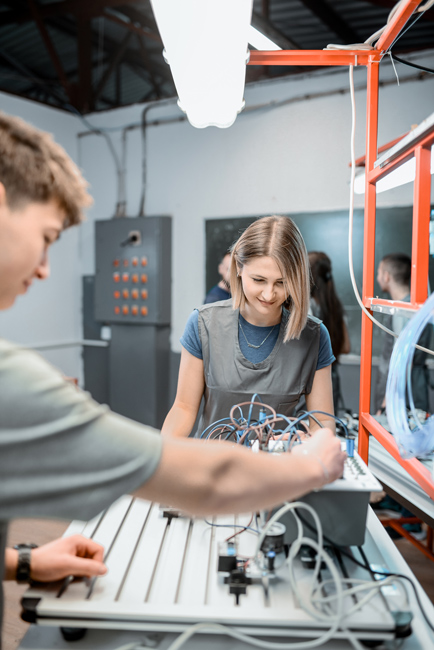
Students work on a training project. Credit: Getty Images

- Eliminates ~15,000 gallons of oil per year
- Reduce site energy by 38% per year
- Reduced site emissions by 64%, or ~127 MTCO2e per year
Institutional Goals
Carbon neutrality by 2035.
Background
The Bard College campus covers approximately 1,260 acres of fields and forested land bordering the Hudson River in New York State. Hidden beneath the bucolic landscape of the main campus lies an interesting academic statistic: nearly one geothermal borehole per every three enrolled students—and that ratio is growing.
Bard has been a leader and early adopter of heat pumps and geothermal, with air-source heat pump systems on campus dating to the late 1980s, and ground-source systems the early 1990s, thanks in large part to the legacy of former Director of Physical Plant, Richard Griffiths, from 1970–1998, who believed in the technology and gave it its debuts. Nearly 50% of the main campus building area utilizes geothermal technology for heating and cooling, and it is the default for all new construction projects. This accounts for more than 40 buildings and nearly 674,000 square feet. There are more than 630 geothermal boreholes hidden beneath the surface across campus.
The Charles P. Stevenson, Jr. Library, located on the Annandale main campus, serves as a critical social and academic hub for the student and faculty community. The Library comprises three buildings: Hoffman (built in 1893), Kellogg (added in 1973), and Stevenson (added in 1993).
All existing HVAC infrastructure within the library—including, but not limited to, the conventional chiller and cooling tower, oil-fired boiler plant, and controls automation system—were all at the end of their useful life. After years of development and careful planning, the library was identified as a candidate for the first existing building to be retrofitted with ground-source heat pumps and paired with a geothermal borefield, consisting of 50 boreholes each at a depth of 500 feet.
Solutions Explored
Bard’s Office of Sustainability works closely with the Operations and Facilities teams on a deferred maintenance plan, identifying buildings with HVAC systems nearing their end-of-life and replacement cycle. This has essentially become the step-by-step process for prioritizing buildings that are candidates for an energy overhaul.
The Library's HVAC system, approaching 33 years old, was identified as a priority for replacement. But rather than simply replace the system one-for-one with conventional equipment—and locking in fuel oil for the next 25 or more years with no payback—the College saw the opportunity to transform the building's energy infrastructure. Recognizing the adjacent field as a resource for a geothermal borefield, and wanting to reduce the building's energy and carbon footprints, and eliminate fuel oil use in perpetuity, the project team pursued a new, integrated heat pump plant to provide heating and cooling. Although the transformation was a more costly effort, the long-term energy savings and improved maintenance outlook, in the context of building that will hopefully last for another century or more, made the decision and easy one, given Bard's successful track record of geothermal on campus.
Solutions Implemented
Brightcore, a renewable energy solutions provider, delivered services starting with feasibility and design, drilling and ground loop installation, establishing mechanical connections, and procuring incentives, and will, upon completion, perform ongoing system performance monitoring.
For the Stevenson Library, 50 boreholes were drilled to a depth of 500 feet, containing 1-¼-inch-diameter geothermal loops and thermally enhanced grout. Previously, 500 feet was the maximum depth one could drill without a mining permit, but now regulations are being developed to make geothermal boreholes exempt by New York law. On Manhattan, boreholes are often angled and go deeper—up to 2,000 feet in some cases.
Financing
The geothermal conversion and HVAC overhaul at the Stevenson Library was funded using a traditional loan structure, supported by NYS Clean Heat incentives and federal Investment Tax Credits made eligible to nonprofit entities via the Inflation Reduction Act.
Timeline
- 1893—Hoffman Library is constructed
- 1984—First air-source heat pump building comes online at Bard College
- 1994—First geothermal (ground source) system is installed at Bard College
- Late 1990s—Geothermal becomes default system for all new construction
- 2024—Construction begins for geothermal conversion of the Charles P. Stevenson, Jr., Library
Lessons Learned
- Ground source heat pumps yield the greatest energy efficiency. Bard has been an early adopter of ground-source heat pump technology, dating back to the 1990s, when their first geothermal project came online. In 2011, Daniel Smith, then the recently hired Energy Efficiency Coordinator, did a baselining study to review the energy efficiency of all buildings on campus. At that point in time, it came as no surprise that the buildings with ground source and air source heat pumps were operating the most efficiently compared to traditional fossil-fuel-based heating and cooling systems. Today, Smith, now Energy Manager and Special Projects Coordinator, has inherited the legacy of geothermal at Bard and has strived to transform the entirety of the campus energy infrastructure, including campus-wide LED lighting upgrades, building HVAC and controls upgrades, envelope improvements, and on-site renewable energy systems.
- Geothermal boreholes last and last. Geothermal borefields are static, with no moving parts except the big loop pumps that circulate water between the field and the building. When installed and maintained properly, they are unlikely to experience failures, potentially lasting 75 years or more. Maintenance is still needed for some building-side components: the heat pump plants that perform the heat-exchange process for heating and cooling need maintenance, though typically less than conventional equipment that is exposed to harsh exterior environments such as rooftop cooling towers. These have a lifespan of typical mechanical equipment and will need to be replaced every 20 to 30 years.
- Borehole drilling technology has evolved. Drilling no longer needs to be linear or horizontal; now you can drill at an angle, allowing for more creativity with orientation and location.
Stakeholders Engaged
- Brightcore Energy, LLC
- Bard Administration and Finance teams
- Bard Operations team
- Bard Library staff
- Town of Red Hook Building Department
- OLA Engineering
- T.McElligott Mechanical
- Eastern Heating & Cooling
- O&D Electric
- Chesapeake Geothermal
For More Information
Bard College
30 Campus Road
Annandale-on-Hudson, NY 12504
Daniel J. Smith, CEM, LEED AP
Energy Manager
[email protected]
Training High School Students for Clean Energy Jobs

Working together on a training project. Credit: Getty Images
The Capital Region BOCES HVAC/R training program includes instructional components that are related to the use, installation, repair, and maintenance of equipment commonly found in the energy efficiency and clean technology fields. This equipment includes high-efficiency cooling systems (air conditioners) and heat pumps.
As part of the NYSERDA-funded training program, students can receive the following training and certifications
- HVAC/R training
- 10-hour Occupational Safety and Health Administration safety course
- National Grid’s Dig Safe training
- Environmental Protection Agency (EPA) 608
- Corrugated Stainless Steel Tubing (CSST) Certification
- ESCO HVAC Excellence H.E.A.T PLUS
“It’s important when entering the industry to know how to work on as many different systems as possible.”
- Valerie Sonnenfroh, Class of 2025 HVAC/R graduate from Schalmont
“The industry is constantly changing and new technologies are being developed so it’s great to have the newest equipment to work on.”
- Spencer Tracy, Class of 2025 HVAC/R graduate from Mohonasen
Learn more about how NYSERDA can fund your own clean energy training program.
Visit NYSERDA’s Workforce Development and Training program page, or email [email protected].