

Comfort Home Case Study
Warren County

Weatherization Matters, and Insulation Makes the Difference
A homeowner participates in NYSERDA’s Comfort Home program and is thrilled with results.
Temperature Differentials, No Comfort
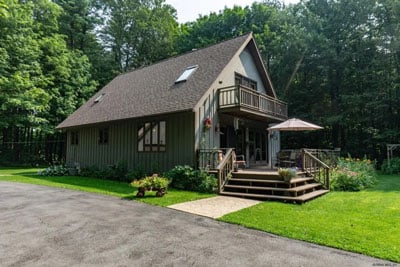
A homeowner located in the foothills of the Adirondacks was struggling with huge temperature differentials in their 1800-square-foot home.
Since purchasing their house in 2021, they rarely spent time upstairs because it felt either stuffy and hot or frigidly cold. The basement, meanwhile, was cold and humid. To gather data, they bought three $5 thermometers and put one on each of the three levels- basement, first, and second floors.
The owner discovered there was always a 20- to 25-degree temperature spread and 20% humidity difference between basement and the second floor. For example, it was 50-55°F in the basement, in the 80s on the second floor, and only 60° outside. On hot days, the attic reached 120°.
The owners turned to NYSERDA’s Comfort Home program for help. Working with Adirondack Efficiency, trained and certified by the Building Performance Institute, they learned what was causing the problem and how to fix it.
Comfort Home Program = Homeowner Comfort
When Adirondack Efficiency examined the home, they identified a few culprits leading to discomfort and high energy bills.
“This home was built to the standards of its day, but now we can do better with air sealing and targeted insulation work,” said Jennifer Monroe, owner and energy auditor for Adirondack Efficiency. “The home had outside air coming in through the basement and poor insulation in the upper levels driving heat loss out through the attic and roof. We designed a solution to address both the air leakage and insufficient insulation that would also add more usable space in the home.”
The team at Adirondack Efficiency removed the old insulation from the basement rim joist then air sealed and insulated with expanding spray foam.
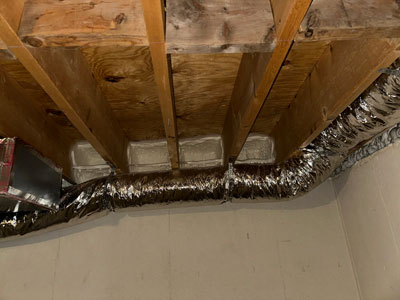
Grey rectangles of spray foam insulation on basement rim joists.
Photo Source: Adirondack Efficiency
Within an hour of the rim joist work, the customer reported the basement temperature was up 7° even though it was in the 40s outside that day.
In the attic, where the furnace and A/C unit were located, floor insulation left both the heating and cooling equipment exposed to outside temperatures, making them work extra hard. The Comfort Home project included removing the old insulation, then applying expanding spray foam to the underside of the roof. This attic space, along with the heating and cooling equipment, is now insulated from the outside temperature.
After the closed cell spray foam was installed in the attic rafters, the customer reported the humidity level throughout the whole house was consistent and only a 5° temperature difference from basement to the second floor.
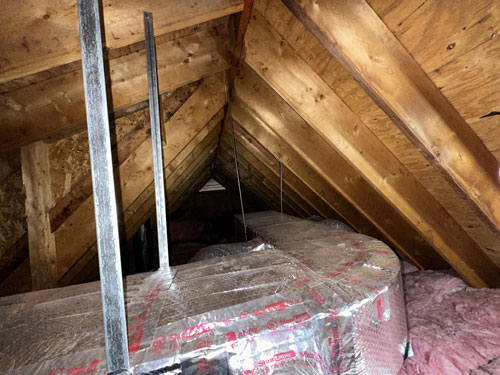
Attic before spray foam insulation.
Photo Source: Adirondack Efficiency
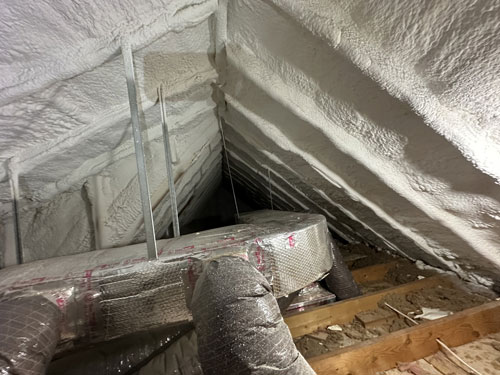
Attic after spray foam insulation.
Photo Source: Adirondack Efficiency
“I rarely spent time upstairs because it was stuffy and hot or frigidly cold. Now I find myself wandering upstairs at odd times just to marvel at how pleasant it is. The [insulation] work … doubled my useable square footage in the cold and hot extremes of the year. This means more than all of our other remodel work.”
Steady Indoor Temperatures in Severe Cold
“Prior to having the insulation work done, the air source heat pump could not reach the set temperature in the coldest month of the winter and warmest month of the summer. Since the insulation package was done I can always reach the set temperature between 65 and 70 degrees, even during the cold winter of 2025-2026 for the heating, and the air conditioning in the late summer,” said the homeowner.
In prior years, the family reported having to shut down the second floor. Now, because of the Comfort Home program, they can fully enjoy their house year-round and save money on their heating and cooling bill.
Comfort Home Incentive Packages
| Good Package | Better Package | Windows Add-On | |
|---|---|---|---|
| Upgrade | Seal and insulate attic and rim joist | Good Package plus insulate walls and floors | After air sealing and insulating, upgrade windows to ENERGY STAR® |
| Value | The average home saves 14% on their heating and cooling bills after installing this package. | The average home saves 20% on their heating and cooling bills after installing this package. | For homes with upgraded air sealing and insulation, upgrading the windows saves an average of an additional 8% on heating and cooling bills. |
| NYSERDA Incentive | $2,500 | $3,000 | $1,000 to $2,000 |
For an in-home, no-cost energy assessment, contact one of our Comfort Home contractors today.
Learn More
Do you want to save energy and increase the comfort of your home year-round? Visit myenergy.ny.gov/comfort  or contact NYSERDA at (866) NYSERDA.