We use first- and third-party cookies and similar technologies for enhancing your experience, personalization, analytics, advertising, and improving our site. By using this website, you consent to our use of cookies. You can learn more about how we collect and use information by reviewing our Internet Privacy Policy.
Modernizing New York State's existing buildings requires innovative solutions and the ability to scale the adoption of clean, energy efficient technologies. Room heat pumps offer a practical pathway to upgrade thousands of multifamily buildings across New York.
Through strategic partnerships with manufacturers and building owners, NYSERDA is accelerating the development and deployment of these technologies while collecting critical performance data to build market confidence and drive widespread adoption.
NYSERDA is investing in product development and field demonstrations to ensure room heat pumps perform reliably in New York's diverse climate.
Product development. NYSERDA has vetted and collaborated with room heat pump manufacturers to identify products that have been developed to meet New York building owner’s rigorous performance and quality standards.
Field demonstrations and real-world performance data collection. Once a product is ready, NYSERDA is connecting building owners with these qualified manufacturers to host subsidized field demonstrations that include collecting real-world performance data.
Third-party testing. NYSERDA is collaborating with the Syracuse University Center of Excellence in Environmental and Energy Systems (SyracuseCoE) to test the qualified room heat pump products to better understand the true, seasonal cost of operation in New York’s climate conditions.
Program Offerings for Multifamily Building Owners
NYSERDA provides funding to lower the cost of installing room heat pumps for New York State multifamily building owners.
Window Heat Pump Field Demonstration Incentives
$2,250 per window heat pump installed in low- to moderate-income dwellings.
$1,500 per window heat pump installed in market-rate dwellings.
Incentives are capped at 100% of total project cost (material cost + installation cost), and the total project incentive cap is $500,000.
Through-Wall Heat Pump Field Demonstration Incentives
Up to $20,000 per apartment for through-wall heat pump installation and demonstration.
Capped at 100% of total project cost (material cost, installation cost, building make-ready work)
Why Choose Room Heat Pumps?
Room heat pumps have the following advantages over other multifamily heating and cooling solutions:
Lower upfront cost and installation complexity As a packaged product, there is no refrigerant piping, limited electrical upgrades needed.
Faster installation timeline Little design needed for each project; faster install.
Minimal resident disruption during installation
More consistent, comfortable outcomes for customers (temperature control, potential for improved indoor air quality throughout all seasons).
Local Law 97 compliance
Is Your Building a Good Fit for Room Heat Pumps?
The table below shows the ideal building characteristics for room heat pump retrofits, but it’s also a good idea to explore a more detailed comparison of the applicability of room heat pumps vs. other heat pump systems.
Window Heat Pumps
Through-Wall Heat Pumps
Existing Heating System
Electric Resistance
Good fit
Good fit
Oil Fired Boiler
Good fit
Good fit
Gas Fired Boiler
Conditional Recommend evaluation of seasonal operating cost impacts
Conditional Recommend evaluation of seasonal operating cost impacts
District Steam
Good fit
Good fit
Existing Floor Plan
Single or Double-Hung Windows in Living Room and Each Bedroom — at least one window without fire escape obstruction or other façade constraints
Good fit
PTAC Sleeve in Every Room
Good fit
Metering Type
Master Metered
Good fit
Good fit
Sub-Metered
Good fit
Good fit
Direct Metered - Market Rate
Good fit
Good fit
Direct Metered - LMI
Conditional Owner must have a strategy in place to account for heating cost shift to tenant electric bill
Conditional Owner must have a strategy in place to account for heating cost shift to tenant electric bill
Size of Retrofit
Full Building
Good fit
Conditional Current program supports retrofitting approximately 5–10 dwelling units per building.
Partial Building
Good fit
Good fit
Program Application Steps
Host a Window Heat Pump Demonstration
Confirm your eligibility.
You must be seeking to install at least 10 window heat pumps.
Your property must be located in New York State.
Low-to-moderate income (LMI) sites are required to submit documentation to NYSERDA demonstrating that PWHP installation will not result in net increased housing costs for LMI tenants.
Partner with a qualified vendor to apply for a field demonstration.
Once you have selected a qualified vendor and approved their proposal, the vendor will submit an application for the proposed project.
The application requires demonstration site floor plans, project scope and proposal, building owner information, and affordable housing verification documents (if applicable).
NYSERDA will accept applications until June 30th , 2027 or until funding is exhausted.
NYSERDA will review the application and recommend technical adjustments, as needed. Once approved, the vendor may move forward with installation and commissioning,
Please also note:
Participants may pursue either a partial or a whole building retrofit.
You will not be required to fully decommission or remove your building’s legacy heating system. For the units in which the room heat pump is installed, your legacy heating system must be turned off for a minimum of (30) consecutive days during the peak winter heating period.
Monitoring and evaluation will be carried out at select window heat pump demonstration sites.
Host a Through-Wall Heat Pump Demonstration
Confirm your eligibility.
Your building must have 5+ dwelling units
Low-to-moderate income (LMI) sites are required to submit documentation to NYSERDA demonstrating that PWHP installation will not result in net increased housing costs for LMI tenants.
Express your interest.
Multifamily owners that are interested in hosting a field demonstration at a building located in climate zones 5 or 6 [PDF] should respond to RFQL 5937 to get qualified.
Pre-qualification has closed for buildings located in NYC and Westchester County, if your building is in this region please connect with a qualified through-wall heat pump provider to explore your options.
Building owners that submit a response to RFQL 5937 will be notified by NYSERDA if their building is qualified for a field demonstration.
Partner with a qualified vendor to apply for a field demonstration.
Once you have selected a qualified vendor and approved their proposal, the vendor will submit an application for the proposed project.
NYSERDA will review the application and recommend technical adjustments, as needed. Once approved, the vendor may move forward with installation and commissioning and will work with NYSERDA on a performance monitoring plan.
Please note:
To be eligible for Program funding, field demonstrations must be installed by December 31, 2027.
Participants may pursue partial or whole building retrofits, but funding will likely allow for retrofits of ~5-15 apartments, depending on how the vendor decides to allocate their incentive funding.
You will not be required to fully decommission or remove your building’s legacy heating system. For the units in which the room heat pump is installed, your legacy heating system must be turned off for a minimum of (30) consecutive days during the peak winter heating period.
Qualify a Heat Pump Product (Heat pump manufacturers or vendors)
For window heat pump products: You may apply to become a Qualified Participant by demonstrating that your window heat pump product(s) meet the program’s technical specifications, including cold-climate performance, energy efficiency and plug-and-play installation requirements. Learn More .
For through-wall heat pump products: NYSERDA is no longer accepting responses to PON 5937 for qualifying through-wall heat pump products.
Room heat pumps are plug-and-play heating and cooling solutions that minimize electrical service or building electrical infrastructure upgrades, which can mean substantial cost savings. Unlike central systems that require extensive ductwork or mini-splits that need ample space for outdoor compressors and refrigerant lines, room heat pumps install directly into existing window or through-wall openings—making them ideal for retrofits to provide both heating and cooling from one piece of equipment.
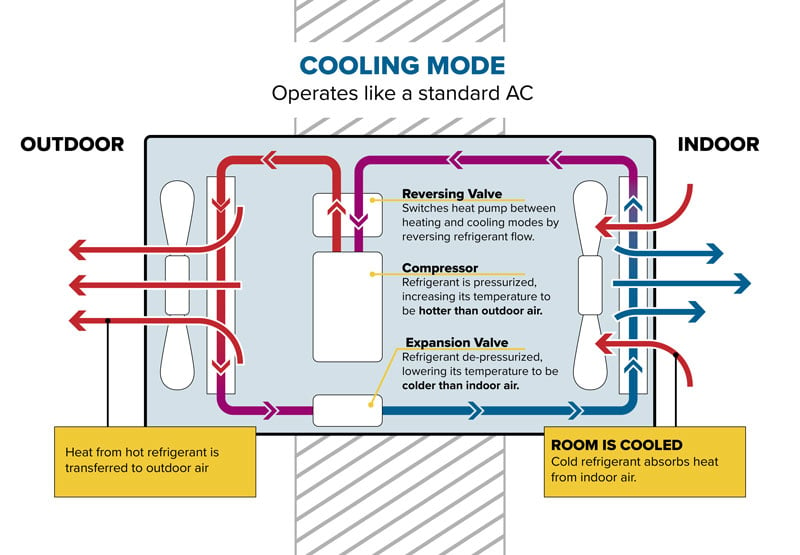
A room heat pump in cooling mode operates like a standard air conditioner.
Refrigerant moves in a closed loop through the heat pump. Cold refrigerant moves through the indoor heat exchanger where it absorbs heat from the indoor air, cooling the room. Warmed refrigerant then flows to the compressor, where it is pressurized, which raises the temperature of the absorbed heat, making the refrigerant hotter than outdoor air. The hot refrigerant next flows to the outdoor heat exchanger and transfers heat to the outdoor air. The warm refrigerant then passes through an expansion valve which de-pressurizes it, lowering its temperature to again be colder than the indoor air, and the cycle repeats.
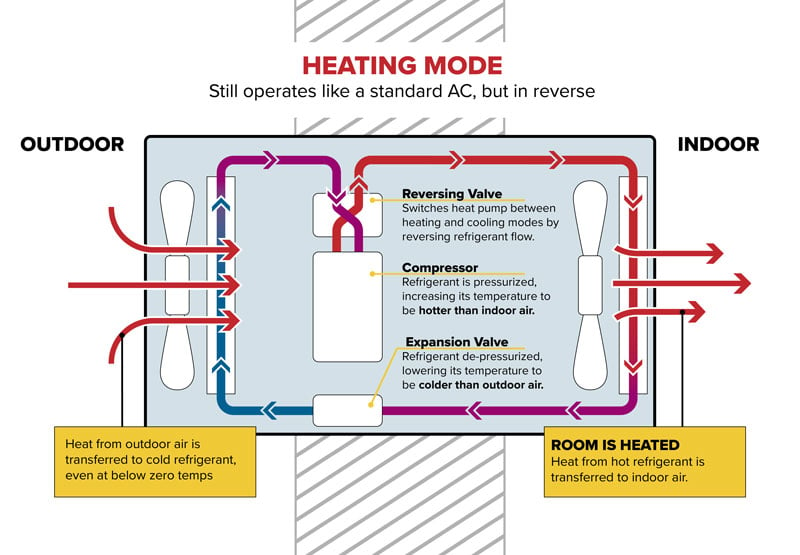
A room heat pump in heating mode operates like a standard air conditioner, however a reversing valve reverses the flow of the refrigerant through the closed loop within the heat pump so heat in transferred indoors instead of outdoors.
Cold refrigerant moves through the outdoor heat exchanger where it absorbs heat from the outdoor air. Warmed refrigerant then flows to the compressor, where it is pressurized, which raises the temperature of the absorbed heat, making the refrigerant hotter than indoor air. The hot refrigerant next flows to the indoor heat exchanger and transfers heat to the indoor air, heating the room. The warm refrigerant then passes through an expansion valve which de-pressurizes it, lowering its temperature to again be colder than the outdoor air, and the cycle repeats.
The Room Heat Pump Program supports two categories of room heat pump products:
Window Heat Pumps
Window heat pumps are designed to replace traditional window air conditioners, transforming cooling-only units into year-round heating and cooling solutions. These innovative products fit standard window openings and offer an accessible entry point for energy efficient retrofits.
Through-Wall Heat Pumps
Through-wall heat pumps are designed for buildings with through-wall sleeves and can provide efficient heating and cooling without major infrastructure changes. They replace existing equipment in three categories:
Category 1
Standard-size Packaged Terminal Air Conditioning (PTAC)
Room heat pumps designed to replace PTACs in standard-size wall sleeves, typically measuring 16” high and 42” wide. Standard-size PTACs provide air conditioning and heating, typically through an inefficient electric resistance heating element.
Standard-size PTACs are common in multifamily buildings and hotels.
Category 2
PTAC in Hydronic Cabinets
Room heat pumps designed to replace PTACs in hydronic heat cabinets. Existing hydronic PTACs provide air conditioning while heating is provided by a central hydronic system. This category of heat pumps will provide both cooling and heating without relying on the central system.
Hydronic PTACs are common in post-2000 multifamily buildings, especially in New York City.
Category 3
Through-the-wall Air Conditioning
Room heat pumps compatible with through-wall sleeves designed to house through-the-wall air conditioners, providing year-round heating and cooling in a space where traditional through-the-wall ACs provided only cooling.
Common in multifamily buildings throughout New York State.
NYSERDA-Vetted Window and Through-Wall Heat Pumps and Vendors
NYSERDA has vetted the following manufacturers through the Room Heat Pump Program for both through-wall and window heat pumps.
Room heat pumps designed to replace PTACs in hydronic heat cabinets. Existing hydronic PTACs provide air conditioning while heating is provided by a central hydronic system. This category of heat pumps will provide both cooling and heating without relying on the central system.
Who submits the application for the window heat pump and through-wall heat pump incentives?
The qualified manufacturer is responsible for submitting the application for incentives.
However, if requested by the owner, the owner may submit documentation directly to NYSERDA.
Please note that the qualified room heat pump providers have decision-making power for their award allocation. This means that not all interested or qualified building owners may receive incentives for their project.
Who is paid the incentive?
NYSERDA issues incentive payments directly to the qualified manufacturer. NYSERDA generally expects that any incentive is applied as a point-of-sale discount to the owner.
Is Measurement & Verification (M&V) required for all projects, and who pays it?
Window heat pump projects will be evaluated on a case-by-case basis for monitoring, based on owner request and building typology. Through-wall heat pump projects will be required to perform M&V for all installations.
NYSERDA will fully fund all M&V activities. Related costs will not draw from awarded incentive totals.
NYSERDA, alongside our technical partner will directly perform all work required for M&V. The owner and qualified manufacturer are only responsible for coordinating access to units, as needed.
How involved or impacted are individual tenants expected to be?
Typically, most disruption to tenants is expected to be minimal, and limited to providing access to installers, which may take 2-4 hours in each apartment.
If a project is selected for M&V;
Tenants should expect to be contacted once every 3-6 months for feedback on how the room heat pumps are performing, and to allow access to the apartment for the installation and collection of M&V equipment.
Tenants will also be asked to sign a Data Release Authorization Form (DRAF) which allows NYSERDA to access their utility consumption data with the local utility.
Does the entire building need to be retrofit with Room Heat Pumps?
No, both full and partial building retrofits are eligible. To be eligible, a minimum of 10 window heat pump units must be installed per window heat pump project, and at least 5 dwelling units must be retrofitted per through-wall heat pump project.
Can an owner self-install with their own contractor?
Yes! The installation may be done by the qualified manufacturers selected contractor, the in-house building maintenance team, or the owner’s preferred contractor.
Does the existing heating system need to be decommissioned or removed?
No, the existing system may be left in place for emergency back-up. NYSERDA expects that the Room Heat Pumps are used as the primary heating system, defined as the existing heating system being:
Turned off for a minimum of (30) consecutive days during the Winter heating period OR
Turned off unless the mechanical rooms drop below 38 F, or the apartments drop below 68 F
Window heat pumps reduced the heating energy intensity by over 75% from the previous 2-pipe steam system at NYCHA Woodsite Houses. See the full detailed performance results in this report.
Live in Connecticut, Maine, Massachusetts, New Hampshire or Rhode Island? Check out the stackable heat pump incentives from the New England Heat Pump Accelerator
Learn how California’s Market Transformation Administrator (CalMTA) is partnering with room heat pump manufacturers to drive improvements to meet California’s varied climate.
Co-op and condo owners can use the simplified application process to access energy-efficiency project loans designed specifically to make it easier to finance smaller projects (up to $800K).
Explore incentives and financing options as well as free resources including project guidance, trainings, project scoping, retrofit management and LL97 compliance status.
Have Questions?
For any additional questions you may have, or for general support and guidance about the Clean Heat for All: Room Heat Pump Program, reach out and our team will be happy to help.