

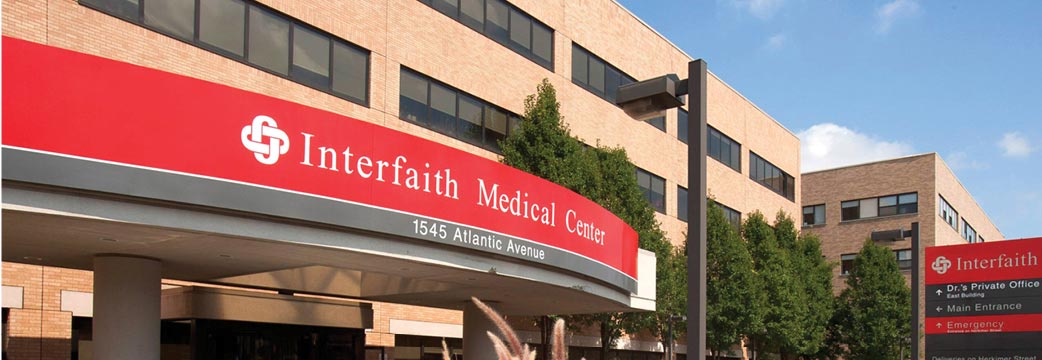
Interfaith Medical Center
Kings County

Brooklyn-Based Healthcare Facility Identifies Opportunities to Increase Energy Efficiency and Comply with Local Laws
NYSERDA’s On-site Energy Manager Program helps build a roadmap to future savings.
One Brooklyn Health System Inc. co-operates a treatment hospital with Interfaith Medical Center (IMC). Together, their system works to enhance healthcare services in the communities of Central and Northeast Brooklyn, a region with significant health disparities such as higher rates of chronic diseases and limited access to quality healthcare.
Initial Energy Goals
Due to renovations over the years, the campus had different HVAC system types of varying ages that created operational and integration challenges. There was also administrative awareness of responsibilities to comply with several local energy-related and greenhouse gas emission laws.
One Brooklyn Health and IMC applied to NYSERDA’s On-site Energy Manager (OsEM) program, which offers a cost-share for industrial, commercial, and multifamily facilities or buildings to hire a dedicated full- or part-time energy manager, to help track energy use and reach energy-related goals.
Project at a Glance
Location: Kings County
Campus size: 4 buildings, 395,142 sq.ft.
Current systems: Natural gas steam boilers for heat and domestic hot water
Annual energy use: 64,228 MMBtu
Local Law compliance: LL84, LL88, and LL97
Partnering with NYSERDA, Salas O’Brien
Once in the OsEM program, One Brooklyn Health and IMC contracted with Salas O’Brien Consulting and Engineering Group of New York, Inc. for a part-time energy manager engagement over 21 months.
The energy manager integrated into the facilities services team, which included a facilities director, staff mechanics, shop personnel, and 3rd-party vendors. An energy management plan was developed first to document reduction goals and savings opportunities.
As a team, they developed specific program goals, which included:
- Identifying energy efficiency and carbon reduction initiatives
- Tracking on-site energy and carbon consumption and cost
- Reducing total energy consumption by 10%
- Creating a quarterly reporting process
Early Analysis: Load Reduction
Projects that targeted load reduction were analyzed early. Two steam boilers running on natural gas, which were used for most heating and domestic hot water, were evaluated for optimization and functionality. Steam traps and pipes were identified for repair and replacement.
Additional load-reduction analysis included envelope evaluation, roof insulation, windows, and air sealing. To reduce heat loss/gains, various upgrades and replacements were recommended.
Key Action: Evaluate and Repair Steam Traps
Throughout the facility, more than 70 steam traps were identified. The survey revealed more than a dozen were deficient and were either blowing or leaking, resulting in wasted energy and inefficiencies in the boiler system.
Steam trap repairs were approved for implementation and installed in the first quarter. The OsEM assisted with securing an incentive through National Grid’s Gas Efficiency Program to aid with implementation.
Evaluation for Additional Incentives
The energy manager identified several programs that offered incentives for electrification and electrification-readiness efforts. After discussions with facilities staff, the energy manager also prepared an application package to NYSERDA’s Empire Building Challenge that included domestic hot water electrification and roof replacement.
Additional projects evaluated for incentives included high-efficiency lighting and controls upgrades, solar PV installation, and building management system expansion via fan coil unit controls.
Assistance with New York City Local Law Compliance
The energy manager prepared and submitted for the 2025 filing year the required compliance documentation to New York City’s Department of Buildings for the following local laws:
- Local Law 84
This law requires annual energy benchmarking using the EPA’s (Environmental Protection Agency’s) ENERGY STAR® Portfolio Manager. The energy manager reviewed meter information and ensured proper data setup and connections between the facility’s utility platforms and the portfolio manager system.
- Local Law 88
This law requires lighting system upgrades that meet New York City’s Energy Conservation Code and electrical sub-meter installation for applicable tenant spaces by 2024.
The energy manager performed full-building lighting surveys to establish existing conditions and prepare recommendations for fixture and control upgrades. An incentive application for Con Edison’s lighting program was also prepared to supplement the installation cost.
- Local Law 97
As part of one of the city’s plans for reducing emissions, the law (LL97) requires buildings to meet greenhouse gas emission limits beginning in 2024, with stricter limits coming into effect in 2030.
The energy manager and her team measured the facility to calculate the gross floor area square footage and develop floor area stacking diagrams. Using the stacking diagrams and the LL97 rule adjustment for non-profit healthcare facilities, the energy manager calculated the facility’s emissions limit, prepared filing documentation, and submitted the emissions report to the Department of Buildings for compliance.
Results
| Energy Measures | Energy Savings 13% |
Carbon Reduction 11% |
Cost Savings 4% |
|---|---|---|---|
16 identified
|
|
|
|
This engagement successfully demonstrated the value of a dedicated individual to track and pursue energy efficiency and decarbonization projects that adhere to the organization’s goals and reduce emissions. The OsEM was essential in project planning and implementation.
Want to identify areas for improvement, increase your building's energy efficiency, and lower operating costs?
Visit NYSERDA’s On-site Energy Manager program page or contact us at [email protected].