

River Commons
New York County
Approaching Zero: Evaluating Net-Zero Carbon and PTHP integration in Affordable Multifamily Housing Design
View Project Info View Project Info
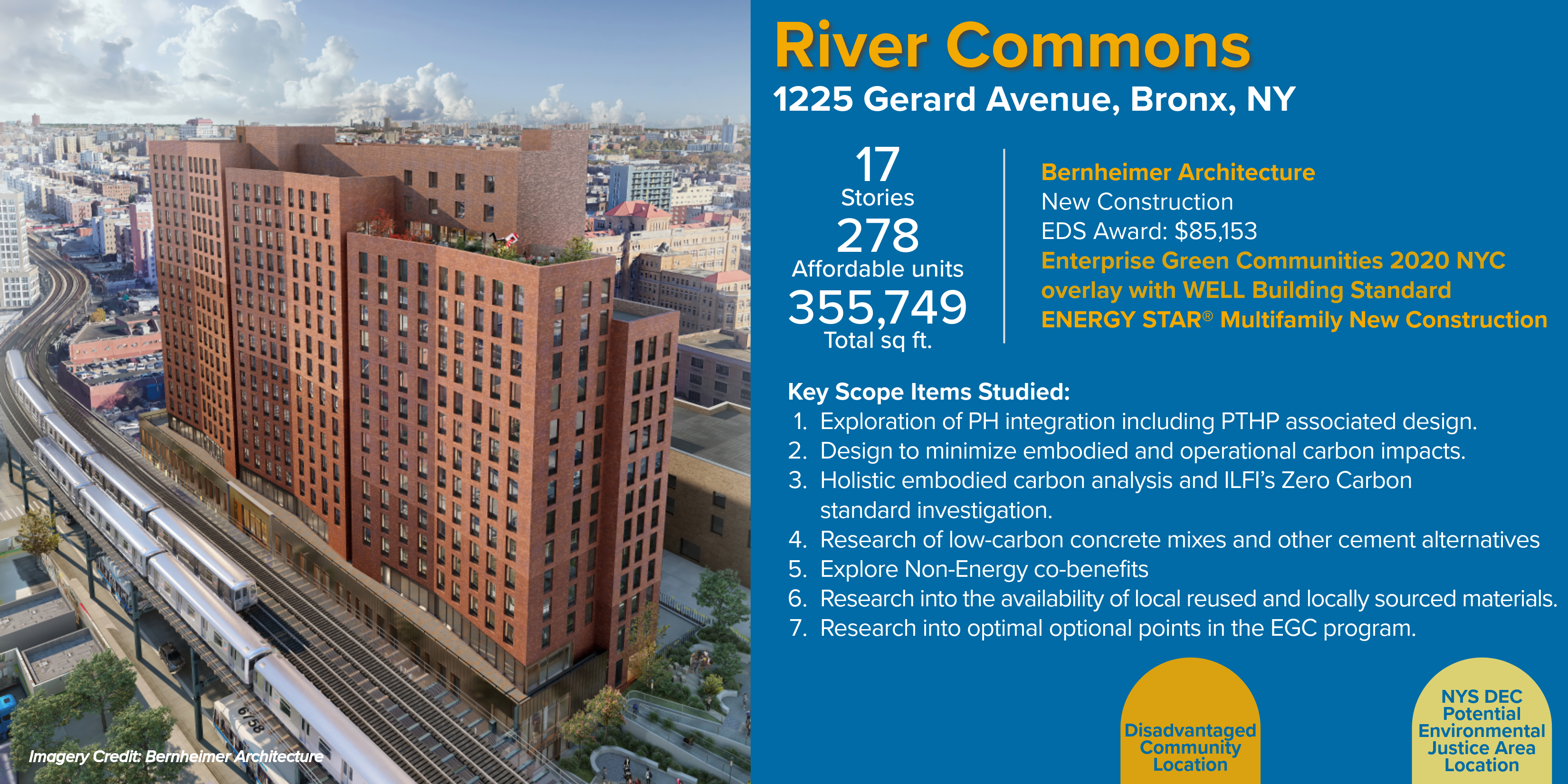
River Commons
1225 Grand Avenue, Bronx, NY
17 Stories
278 Affordable units
355,749 Total sq ft.
- Bernheimer Architecture
- New Construction
- EDS Award: $85,153
- Enterprose Green Communities 2020 NYC overlay with WELL Building Standard ENERGY STAR® Multifamily New Construction
Key Scope Items Studied:
- Exploration of PH integration including PTHP associated design
- Design to minimize embodied and operational carbon impacts
- Holistic embodied carbon analysis and ILFI's Zero Carbon standard investigation
- Research of low-carbon concrete mixes and other cement alternatives
- Explore Non-Energy co-benefits
- Research into the availability of local reused and locally sourced materials.
- Research into optimal optional points in the EGC program.
- Disadvantaged Community Location
- NYS DEC Potential Environmental Justice Area Location
Project Description
Key Findings
View the full report of EDS funded studies:
Designed by Bernhiemer Architecture, River Commons is a 355,749 square foot, new construction, clean and resilient building. Located in a disadvantaged community and a New York State potential environmental justice area within the Bronx, this project will serve the community with 278 units of affordable housing and provide supportive housing for tenants transitioning out of homelessness. The 17-story building includes a community facility space offering health and support services by BronxWorks African Communities Together and the African Advisory Council. Designed to meet Passive House standards, the project reduces energy consumption by utilizing all-electric systems, a geothermal heating and cooling system, and a 140kW solar array. Prioritizing tenant health, safety and comfort, the units provide a range of sustainable features such as high-efficiency appliances, thermal insulation, and a resilient building envelope resulting in superior indoor air quality and noise isolation. Community spaces include a plaza, landscaped rear terrace, and a 4,200 square foot interior common area fostering community connectivity even within the colder months. The use of durable materials and energy-efficient systems contributes to a low-carbon footprint and promotes physical activity through active design elements. Scheduled for completion in Q3 2026, River Commons represents a forward-thinking solution to affordable housing in the Bronx.
Design Team Lead
Bernheimer Architecture (opens in new window)
Developer: Type A Projects, L&M Development Partners, Bronxworks
Early Design Support Project Scope
Funded Early Design Support study for River Commons includes an exploration of the design and performance of the PTHP (Packaged Terminal Heat Pump) systems as an alternative to 'traditional' VRFs. The project also focuses on minimizing both embodied and operational carbon impacts, with a comprehensive embodied carbon analysis and investigation into the International Living Future Institute's (ILFI) Zero Carbon standard. This approach aims to optimize sustainability across all phases of the building's life cycle, ensuring a low environmental footprint while delivering energy-efficient and resilient housing.
Approaching Zero: Evaluating Net-Zero Carbon in Affordable Multifamily Housing Design
This report presents Bernheimer Architecture’s in-depth evaluation of carbon reduction strategies in the design of River Commons, a large-scale affordable multifamily housing project in New York City. This research explores practical, scalable pathways toward achieving net-zero carbon in affordable housing—focusing not only on operational performance, but critically on embodied emissions. Drawing on lessons from previous Passive House and high-performance projects, the study tests Bernheimer Architecture’s internal standards against the rigorous benchmarks of the International Living Future Institute’s Zero Carbon 1.1 framework. While River Commons is not pursuing formal passive certification, the project prioritizes low-emissions design throughout. Findings offer valuable insights into cost-effective energy solutions such as Packaged Terminal Heat Pumps (PTHPs), material selection impacts, and the challenges of reducing embodied carbon within current construction norms. This work reflects the firm’s ongoing commitment to climate responsibility and aims to inform practitioners, carbon-conscious advocates, and project owners seeking actionable strategies for decarbonizing the built environment—particularly within the constraints of affordable housing.
This study identifies a range of actionable strategies for reducing both operational and embodied carbon in affordable multifamily housing. The most impactful reductions in embodied emissions come from targeting lower-GWP structural concrete, wall assemblies, and insulation, with an eye toward meeting ILFI’s Zero Carbon 1.1 threshold of 350 kgCO₂e/m². Surprisingly, windows contribute relatively little to embodied carbon, allowing for generous glazing without significant impact. Interior partitions—especially gypsum wall board—represent a sizable emissions source, suggesting material substitutions can yield meaningful gains. Decentralized HVAC systems like Packaged Terminal Heat Pumps (PTHPs) offer a promising alternative to VRFs by lowering both energy demand and refrigerant volume. Early collaboration with structural and geotechnical consultants is critical for optimizing structural systems and integrating low-carbon solutions like geothermal. Across all strategies, the importance of setting clear decarbonization goals from project inception is paramount—supported by tools like BA’s Affordable Housing Decarbonization Framework to align stakeholders and streamline implementation.
Media
Reimagine Buildings '25 | River Commons (opens in new window)
River Commons is our first to receive direct funding from the NYSERDA Early Design Support RFP in support of net zero readiness and high-performance building design. River Commons is an outstanding example of passive house inspired design applied to large-scale affordable multifamily housing. However, despite its operational efficiency, its embodied carbon underscores the hidden threat to net zero ambitions for buildings of this type and size. Today we will assess the balance of River Common's operational and embodied emissions, extract key data that can inform the future of decarbonization frameworks and conclude with actionable recommendations for other projects pursuing low embodied carbon projects.
The Buildings of Excellence Early Design Support Program
Buildings of Excellence Early Design Support (EDS) Partners are qualified design firms that are elevating new design approaches for a zero emission future in New York’s multifamily buildings that prioritize occupant health, safety, and comfort. Partners are eligible to receive up to $1.50/square foot in direct funding per project, up to a cap of $150,000 per project, to complete carbon neutral research, modeling, early-stage applications for third party standards, economic analyses, integrated project delivery meetings, and more robust marketing and promotion plans to disseminate information out to the market.