

Innovator Story: Manifold Robotics

Transforming Grid Safety with NYSERDA: Manifold Robotics’ New Approach to Power Line Inspection
In 2018, Jeff Laut and Art Julius of Manifold Robotics partnered over an idea for automating how utilities inspect transmission lines. Inspired by a research-driven military project, the idea has since evolved into a cutting-edge inspection tool that proposes to use automated drones instead of helicopters to inspect power lines. This monumental change would decrease the cost of inspections and increase the distances covered, all while strengthening safety and reliability across the grid. The evolution of the equipment and process gained traction with guidance and funding from NYSERDA’s Innovation & Research Program.
Tracing Innovation Back to the Lab
Jeff’s background in robotics research led him to explore how drones could navigate using the existing electromagnetic fields (EMF) around transmission lines. For utilities, this was a compelling idea. While most drones rely on GPS, the accuracy of the technology is often unable to navigate the drone close to the infrastructure. In contrast, electromagnetic field sensing—also known as EM/Nav—enables drones to “see” the lines themselves and use that data as a guide.
The potential application was clear: instead of helicopters hovering over transmission corridors, or drones that could get near but not fully reach the lines, utilities could deploy drones to safely monitor their transmission infrastructure. They could shift between automated and guided drone configurations to repeat executions while maintaining full control. The idea promised increased safety, lower costs, and reduced time in the field for inspections, along with the potential for more varied and detailed close-up and long-range inspections—all contributing to a more reliable power grid.

The NYSERDA Partnership That Made Progress Possible
Turning this concept into a marketable product required structured support, industry connections, and commercialization expertise in addition to engineering. Manifold Robotics found that, and more, in the NYSERDA Innovation & Research team.
Through a NYSERDA product development program, and in cooperation with the New York Power Authority (NYPA), the company began building sensors and testing them in the field. NYSERDA’s grant funding enabled the transition from a lab prototype to a functioning system ready for real-world trials. At the same time, NYSERDA connected Jeff and Art with experienced business mentors through its Climate Tech Expertise Network.
These check-ins helped the technically focused founders develop the skills and strategies needed to grow a business in the energy sector. NYSERDA stayed engaged throughout the process with regular milestone reviews, ensuring the projects remained aligned with industry needs and stayed on track while moving forward efficiently and effectively.
“Without NYSERDA, there’s a high chance we probably wouldn’t have the product we have today,” Jeff notes. “NYSERDA and the New York Power Authority saw the potential, supported us, and as a result we have a promising new technology to help scale utility transmission line inspections.”
— Jeff Laut, CEO of Manifold Robotics
From Prototype Flights to Real-World Validation
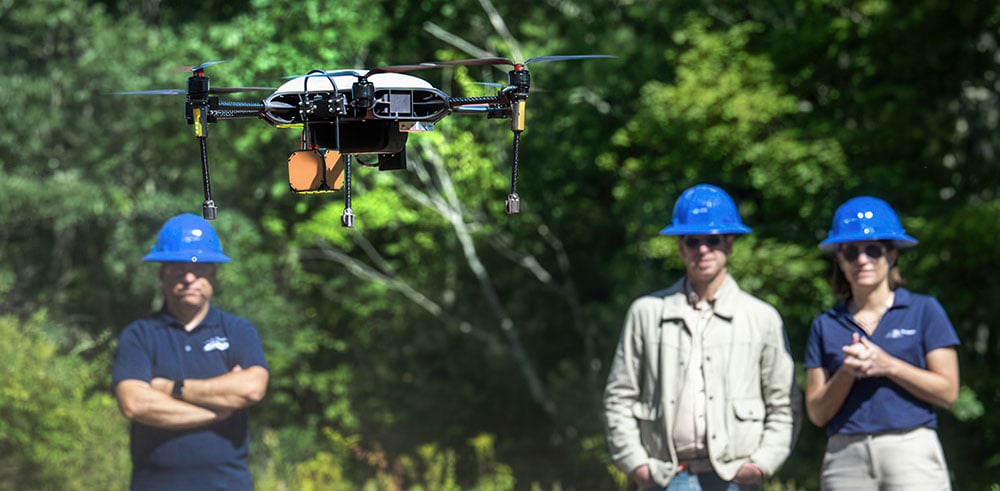
With NYSERDA’s early support, Manifold Robotics first demonstrated sensing technology on multi-rotor drones commonly used for inspections. This established proof of concept and provided Manifold with the data needed to refine algorithms for navigation and collision avoidance.
A second, ongoing NYSERDA project is expanding the technology to eight-foot, fixed-wing drones that travel longer distances and better match the scale of utility infrastructure. Throughout both development phases, NYSERDA also provided technical guidance and commercialization planning.
Public Benefits: Reliability, Affordability, and Cleaner Operations
The shift away from helicopters to drones brings benefits both to utilities and the communities they serve. For utilities, the technology enables safer, more frequent, lower cost inspections that can translate into earlier detection of issues, reducing the risk of outages or problems related to line failures during extreme weather events.
For New Yorkers, the benefits are equally clear. A drone-based inspection program that replaces some or all helicopter inspections reduces helicopter fuel use and the associated greenhouse gas emissions, and cuts noise pollution in neighborhoods near transmission lines. The program can lower inspection costs and improve resilience in the face of storms, all while helping to improve grid reliability.
Building Momentum Through Collaboration and Regulation
Jeff credits NYSERDA’s collaboration as a key driver of Manifold’s progress. NYSERDA’s structure of regular check-ins, skill-building workshops, and commercialization guidance enabled Manifold’s small team to focus on developing and refining their technology while drawing on outside expertise.
This alignment has also positioned Manifold’s technology to address regulatory questions. By enabling drones to fly safely near power lines, the company strengthens the case for securing federal waivers to operate drones beyond the visual line of sight—a key step toward commercial deployment on a larger scale.
“It’s been nothing but a positive experience working with NYSERDA, especially with their team’s deep industry insight. They help ensure you’re developing a marketable product with real commercial application.”
— Jeff Laut, CEO of Manifold Robotics

Scaling Innovation for Statewide Impact
With proven success in multi-rotor applications and development underway for fixed-wing platforms, Manifold Robotics is looking to expand its footprint. The company is exploring pilot project opportunities with utilities across the country, while also working with drone manufacturers to integrate its navigation system as an industry-standard tool.
Manifold’s vision is to make drone-based inspections the standard for utilities—replacing costly helicopter surveys with scalable, safe, and sustainable solutions. For New York, that means a more resilient grid, reduced emissions, and a more affordable path toward a clean energy future.
“There’s a lot to figure out, and it’s great to engage with people who have already navigated these challenges,” Jeff emphasizes. “With NYSERDA’s support, we don’t have to reinvent the wheel—we can focus on developing the technology and solving the problems that haven’t been solved yet.”
Backed by NYSERDA’s sustained engagement, Manifold Robotics has advanced from an early-stage concept into a promising tool for modernizing inspections. What started as a novel idea in a research lab, has matured with the help of valuable program offerings and expert insights from NYSERDA’s Innovation & Research program, and is paving the way for safer, cleaner, and more efficient grid management across the State.
About NYSERDA Innovation & Research
NYSERDA Innovation & Research fosters a dynamic ecosystem that accelerates the development, demonstration, and commercialization of cutting-edge energy technologies. By catalyzing private investment, supporting groundbreaking research, and attracting world-class innovators to New York, NYSERDA advances statewide goals for decarbonization, resilience, and economic growth.