

Policy & Science Advisor Update Q4 2025
Each quarter, NYSERDA’s Environmental Research Program issues an update on the portfolio through the Policy & Science Advisor newsletter. This issue features a study linking clean air policy to measurable ecological recovery in the Adirondacks, alongside program updates spanning ecosystem response, land-based renewables, offshore wind, climate change, and air quality and health.
Featured Research: Fish-Assemblage and Declining Acidic Deposition
Decades of Acid Rain the Adirondacks
Several decades of acid deposition (“acid rain”) affected the lakes, streams, and soils of the Adirondacks making the environment more acidic and less productive. Long term monitoring of precipitation chemistry, stream water quality, and fish populations have made it possible to track the recovery of those environments. While multiple prior studies have documented improvements in water quality of lakes and streams associated with decreased acid deposition, the extent and degree to which biological recovery in Adirondack streams could be associated with to energy-related air quality policies was under-characterized.
NYSERDA-Supported Research with USGS
NYSERDA has long supported the United States Geological Survey (USGS) and other agencies to study the environmental impacts of acidic deposition, including a recent study to evaluate the effects that the 1990 Clean Air Act Amendments and other sulfur (S) and nitrogen (N) emission-reduction regulations have had on chemical and biological recovery of previously acidified streams in the Adirondacks. The study analyzed water chemistry and fish data from 42 headwater Adirondack Region streams, sampled during three periods - primarily in 1979 and 1999 by the New York State Department of Environmental Conservation, and in 2020 by the USGS. The study examined the relationships among nationwide atmospheric emissions, regional wet deposition, and chemical and biological conditions in these streams.
Key Findings: Emissions, Water Chemistry, and Fish Recovery
Total annual emissions of sulfur dioxide (SO2) and nitrogen oxides (NOx) for the contiguous United States decreased by approximately 94% and 87% between 1990 and 2021, respectively. The authors found a strong parallel relationship between this national emissions decline and wet deposition in the Adirondacks, which declined by 88% for SO2 and 70% for NOx over that same timespan. Stream chemistry results varied by watershed, but overall mean acid neutralizing capacity (ANC) and pH of stream waters increased considerably, and mean springtime Aluminum ion concentration (leached from acidified soils) decreased in the 42 Adirondack streams. Between 1979 and 2020, mean fish species richness increased by 112%, biomass increased by 66%, and density increased by 236% at 40 sites. During that time, Brook Trout density and biomass did not meaningfully change, however their distribution expanded from 20 sites to 33 sites.
Policy Implications and Ongoing Certainty
The research found that air quality improvements observed since passage of the 1990 Clean Air Act Amendments were the predominant factors behind the significant reductions in wet deposition of sulfur and nitrogen oxides in the Adirondacks, which led to improvements in temporal trends in water quality and fish assemblages in the 42 headwater streams.
This study’s observations show how scientific information, generated decades ago, can be used to evaluate the effectiveness of prior regulatory decisions and account for whether policies are having intended outcomes. The authors caution that the rate at which acidity in Adirondack streams will continue to decline and whether the modest recovery of fish assemblages will continue is uncertain. Climate change factors, including rising carbon dioxide (CO2) concentrations and shifts in precipitation and temperatures have been associated with recent observations of elevated Dissolved Organic Carbon in the region’s waters. How climate change might affect the chemical and biological recovery of Adirondack streams from acidification warrants further study.
Read the full publication: Fish-assemblage and water-quality recovery with declining acidic deposition in Adirondack mountain streams, New York, USA 
Total annual emissions of SO2 (yellow bars) and N oxides (NOx; blue bars) nationwide under the United States Environmental Protection Agency (USEPA) Emission Reduction Program (ERP; 1970–2021) and mean annual volume-weighted pH (red circles with solid line; 1979–2021), SO42− (yellow open circles), and NO3− (blue open circles) concentrations (1979–2021) in wet deposition at the National Trends Network wet-deposition collector (station NY20). NY20 data were collected every 5 years between 1970 and 1985. Beginning in 1990, data were collected annually.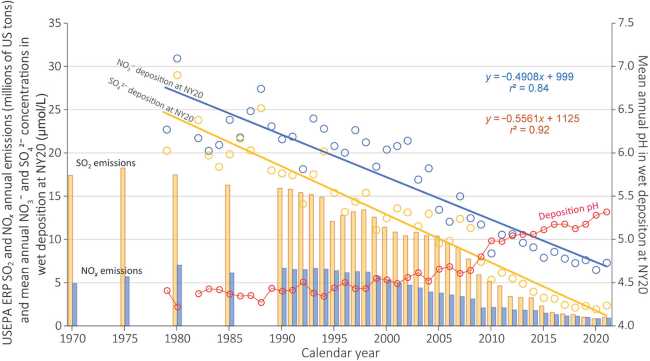
Ecosystem Response
Adirondack Loon Census
The Common Loon is a long-lived (25-30 years), territorial, piscivorous species at the top of the aquatic food web, which makes them excellent bioindicators of threats to aquatic ecosystems and provides a rare opportunity to assess the long-term impacts of climate change and environmental pollutants, such as mercury and acid rain. The Adirondack Center for Loon Conservation (ACLC) posted their results of the 2025 Loon Census which provides a snapshot of the state’s loon population. In total the census observed 407 loon reports on 307 lakes, ponds, and rivers. These yearly censuses provide valuable information on the status and trends of the breeding loon population in New York State and inform natural resource management. The ACLC anticipates opening registration for the 2026 NY Annual Loon Census in the late spring and will provide details to get involved on their website.
Land Based Renewables
Solar Grazing Improves Soil Health, Pasture Quality, and Site Sustainability
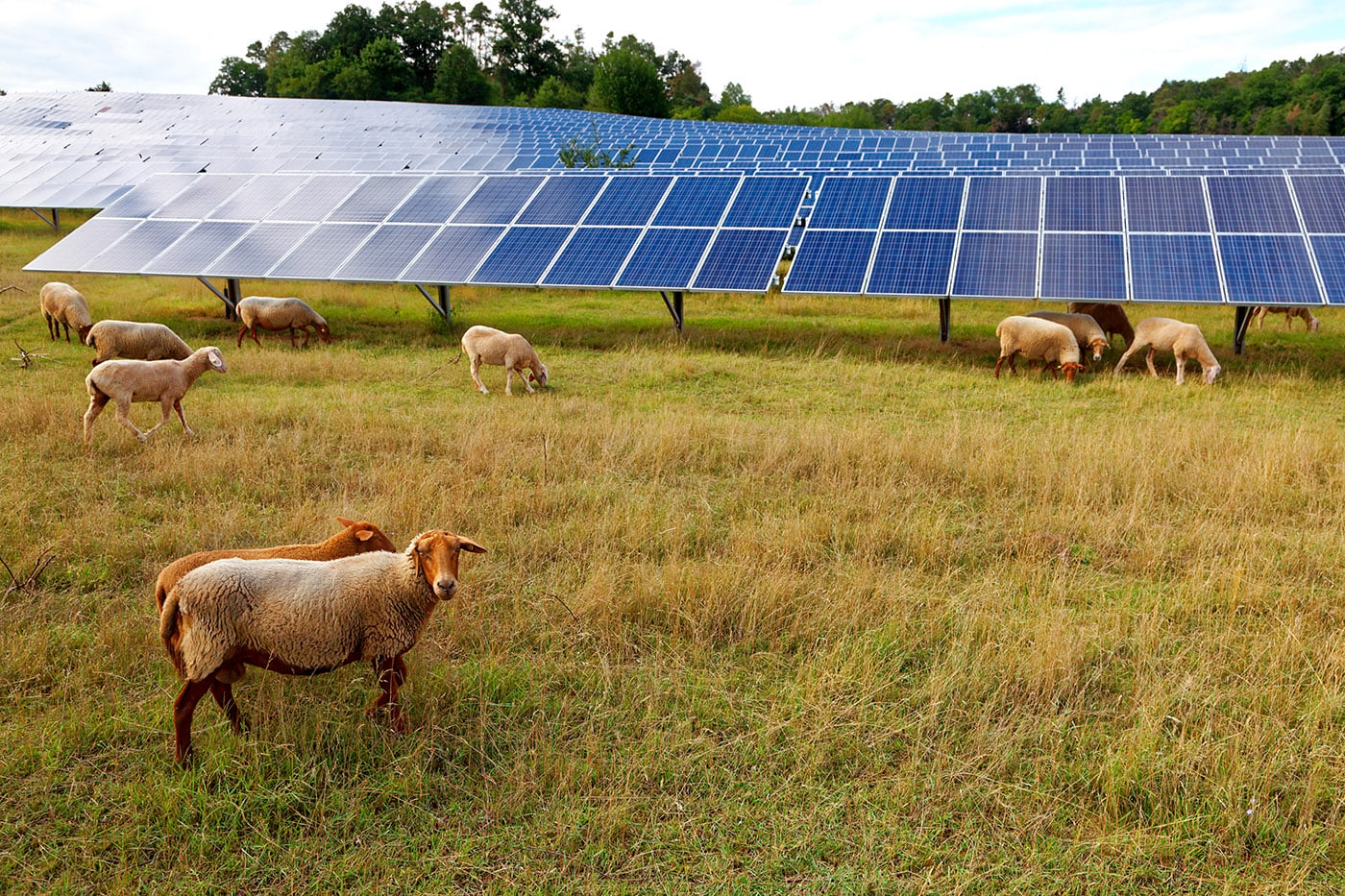
The American Solar Grazing Association (ASGA), Pennsylvania State University, and American Farmland Trust presented their NYSERDA funded solar grazing research study findings on December 3, 2025. The study aimed to expand knowledge of co-location strategies for solar site maintenance. The research found that solar sites with grazing tended to have higher soil organic matter than non-grazed sits and the potential to improve the soil health on solar sites.
Get more information on the latest solar grazing research
Agricultural Technical Working Group (A-TWG)
A-TWG met once in Q4 2025 to: discuss how stakeholder feedback on the A-TWG Regional Agronomic Impacts from Solar Energy (RAISE) Committee’s Phase 1 report was addressed and important questions to address in Phase 2; hone a proposed consensus process for creating issue briefs and other products as a diverse advisory body; use that process to work toward consensus on an agrivoltaics issue brief a subgroup had drafted; and receive and discuss a briefing from the Build Ready Program.
Read the agenda, presentation, and notes
The RAISE Committee met twice in Q4 2025 to provide feedback on the draft report explaining Phase 1 of the committee’s findings, discuss candidate research priorities for Phase 2, and reflect on strengths and areas of improvement for the process and work of the committee to date. Phase 1 report publication is anticipated in late Q1/early Q2 2026.
2025 NY Solar & Storage Summit
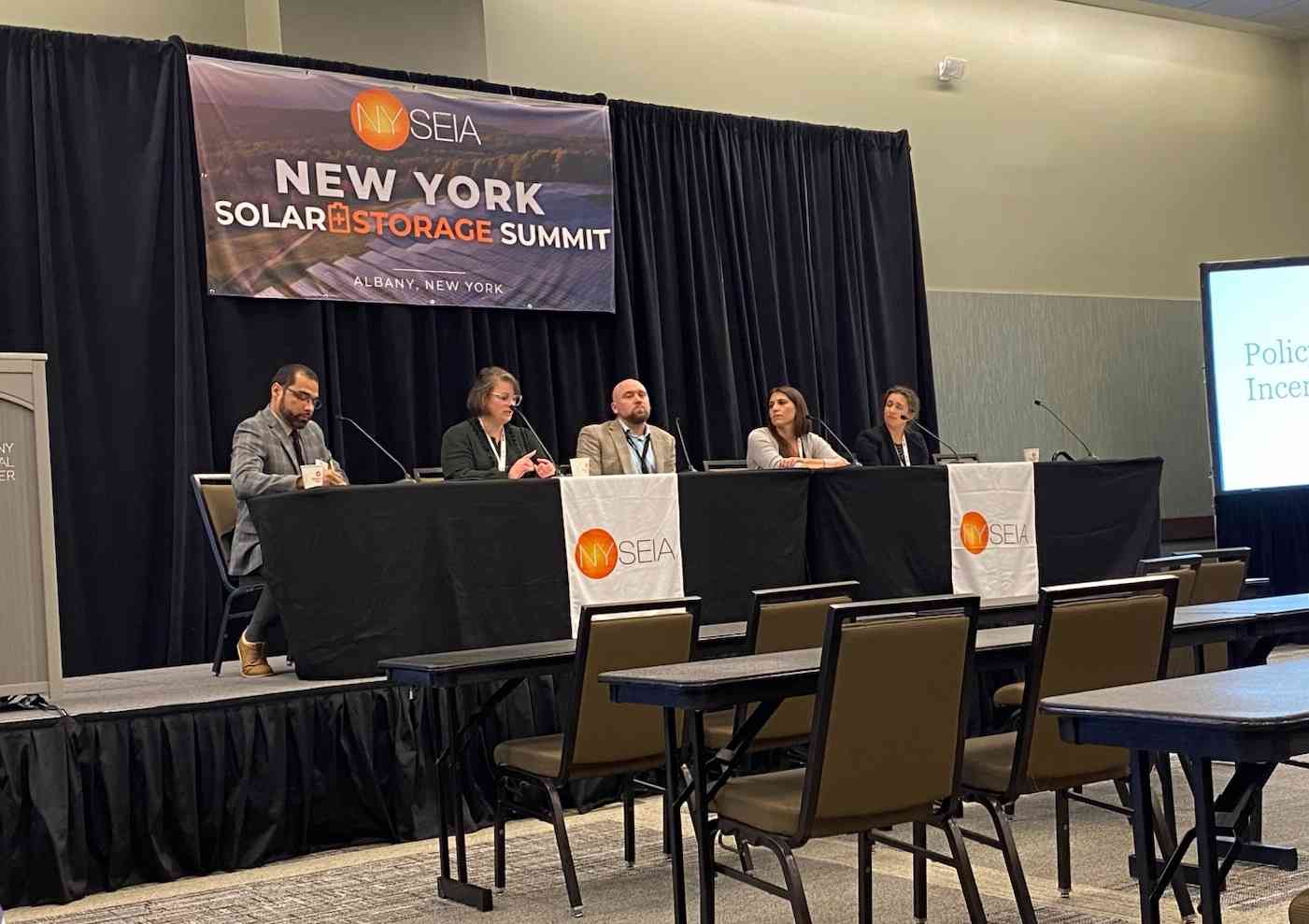
Environmental Research Program Manager Kristin France participated in a lively agrivoltaics panel, “Innovation At the Nexus of Solar and Farmland” at the New York Solar Energy Industries Association’s (NYSEIA) 2025 NY Solar & Storage Summit, alongside leaders from two of the awarded projects from RFP5752 Agrivoltaics Research and Demonstration, Caleb Scott of United Agrivoltaics and Lucy Bullock-Seiger of Lightstar Renewables, as well as Rebekah Pierce, a solar grazer and published author on agrivoltaics.
Offshore Wind
Benthic Monitoring
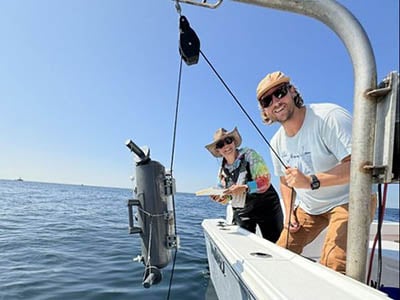
The Nature Conservancy and Stony Brook University released a short video on their NYSERDA-supported work comparing different methods to monitor benthic changes at artificial infrastructure in the marine environment. One goal of this work is to understand the value of nature-based designs to support marine life.
Marine Technology Society (MTS) Tech Surge
Environmental Research and Offshore Wind Team staff attended the MTS Tech Surge at the University of Rhode Island on October 8 through October 9, 2025. This event convened experts from across sectors to explore advancements in monitoring technologies for benthic ecosystems and fisheries that support responsible offshore development. Topics of discussion included advancements in benthic mapping technologies, use of technology to transition from traditional survey methods, including highlights on new innovations, monitoring technologies applicable to offshore development. Kate McClellan Press and Morgan Brunbauer also acted as mentors to graduate students to support relationship building and provide early career advice.
Regional Fisheries Compensation Fund
The multi-state effort to advance a regional fisheries compensation fund continues to make progress. The Regional Fund Administrator (RFA) continues to engage with stakeholders and recently held a virtual for-hire recreational fishing committee meeting on December 16, 2025 and a virtual design oversight committee meeting on December 19, 2025. The objectives of these meeting were to continue to discuss the proposed program rules, advance subcommittee topics for fishing history and permit transferability, shoreside businesses, and expedited cable and construction period design principles. Additionally, the 2026 topic discussion schedule was reviewed to layout the program design agenda for the coming year.
Learn more about RFA meetings and activities
Environmental Technical Working Group (E-TWG)
The E-TWG held a meeting in New York City on November 20, 2025. The agenda included discussion of specialist committee work on science-based communication, the status of planning for the 2026 State of the Science on Offshore Energy, Wildlife, and Fisheries, and coordination of regional research and monitoring efforts.
Explore meeting materials
State of the Science
Registration for the 2026 State of the Science on Offshore Energy, Wildlife, and Fisheries is now open. The conference will take place from June 8-11 at Stony Brook University on Long Island, New York. The theme of the 2026 conference is "Building on a strong foundation: deepening knowledge and finding collaborative solutions".
Climate Change
Research Solicitation
A solicitation for climate research was released in August and received a very robust proposal response. and closed at the end of September. Scoring committees were held for each of the four topics: gaps in heat vulnerability data, climate and indoor air quality, compound events, and climate projections. Contracting with the selected projects is now under way.
Program Research Plan
Development of the climate impacts and adaptation component of the Environmental Program’s research plan continues. Program staff and a consultant met with an advisory group to assist with development of the plan, which will continue throughout the next quarter.
NYS Climate Impacts Assessment (NYSCIA)
Staff are working with a consultant to gather user feedback on opportunities to enhance the content and functionality of NYSCIA website and other outputs. Four feedback sessions were held, engaging with NYSERDA’s Energy Equity Collaborative, New York State agency staff, community liaisons, and adaptation practitioners.
State Energy Plan
The final version of the State Energy Plan was released in December. Program staff co-led development of several chapters, including the climate change and resilience chapter.
Air Quality and Health
AAAR 2025 Conference: NYSERDA Sponsorship and Student Support
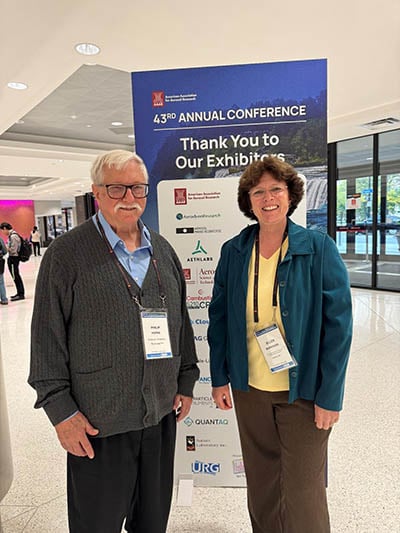
NYSERDA sponsored the American Association for Aerosol Research conference held during October 13-17, 2025, in Buffalo, New York. In addition, NYSERDA provided travel grants for students and post-doctoral associates working on NYSERDA-supported research but without other travel support. A total of 13 students and one postdoc were awarded travel grants and presented posters or platform presentations during the conference. Several other NYSERDA-supported research projects were also represented. Projects included atmospheric measurements of aerosols, precursors, and co-pollutants, source apportionment, source identification, atmospheric chemistry studies, air quality modeling and emissions inventory work.
Program Reports and Papers
Program Reports & Papers posted recently include:
Air Quality and Related Health Research: Particulate Matter (PM), Ozone and Co-Pollutants
Ahmadi, M., Allen, G., Stanway, J., & Traviss, N. (2025). Effect of operating conditions and technology on residential wood stove emissions of criteria, greenhouse gas, and hazardous air pollutants. Journal of the Air & Waste Management Association, 75(6), 483–502. https://doi.org/10.1080/10962247.2025.2488807
Catena, A. M., Smith, M. L., Murray, L. T., Leibensperger, E. M., Zhang, J., Schwab, M. J., and Schwab, J. J.: Aerial estimates of methane and carbon dioxide emission rates using a mass balance approach in New York State, Earth Syst. Sci. Data, 17, 4555–4568, https://doi.org/10.5194/essd-17-4555-2025
Catena, A.; Murray, L.; Zhang, J.; Leibensperger, E.; Commane, R.; Smith, M.; Schwab, M.; Hallward-Driemeier, A.; Loman, M.; and Schwab, J. Intercomparison of Methane Emission Rate Methods Using Aerial and Ground-Level Mobile Monitoring at New York State Landfills. ACS ES&T Air 2026 3 (1), 16-29 DOI: 10.1021/acsestair.5c00145
Goldberg, R., Spira-Cohen, A., Pitiranggon, M., Johnson, S., & Ito, K. (2025). Changes in the short-term relationship between air pollution and mortality in New York City, 1990-2019. Environmental Health, 24:37 https://doi.org/10.1186/s12940-025-01171-w
Hojeily, E.; Covert, J.; Schwab, M.; Moore, C; Lu, C.; Bari, M.; and Miller. S. A Network Calibration Approach Improves the Accuracy and Long-Term Stability of a Low-Cost Air Quality Mesonet in New York City. ACS ES&T Air 2026 3 (1), 58-72. DOI: 10.1021/acsestair.5c00205
Schiferl, L. D., Hallward-Driemeier, A., Zhao, Y., Toledo-Crow, R., and Commane, R.: Missing wintertime methane emissions from New York City related to combustion, Atmos. Chem. Phys., 25, 15683–15700, https://doi.org/10.5194/acp-25-15683-2025
Tripathy, A., Khwaja, H. A., Hussain, M. M., Yerger, E., Kelting, D., Lawrence, C. E., Casson, P., Snyder, P., Lombardo, S., Pittman, N., DeMarle, K., Patel, R., Hammond, L., Apel, E. C., Hornbrook, R. S., Hills, A. J., Brandt, R., McKim, S., Schlemmer, J., and Lance, S.: Organic Acids and Cloud Droplet Acidity in Recent Years at Whiteface Mountain, with Focus on Wildfire Smoke Influence, EGUsphere, https://doi.org/10.5194/egusphere-2025-4983