

Load Reduction: HVAC and Domestic Hot Water Efficiency Strategies
Installing energy-efficient heating, air-conditioning, ventilation, and domestic hot water systems can greatly reduce your overall energy use. Reducing building energy loads in these ways is cost-effective and will help ease demands on electricity, which will, in turn, help you right-size any electrified building systems.
Key Elements to Improve HVAC Efficiency
When evaluating HVAC and domestic hot water systems for possible load reduction opportunities, there are few key items to consider. The ideal end result is that these systems are optimized to operate in the most efficient manner and use the least amount of energy possible.
Right-Size HVAC Systems
Historically, HVAC systems were often oversized because they were sized using simple rules of thumb and excessive safety factors to account for unknown variables like air leakage or insulation levels. This outdated practice led to systems that were too powerful, resulting in inefficiencies and higher costs.
Modern engineering practices have eliminated the need for oversizing HVAC systems to meet peak-day heating and cooling demands. However, high plug loads —the heat generated by electronic devices and appliances—can still significantly influence the required HVAC system capacity. Therefore, effectively right-sizing HVAC systems depends on a detailed evaluation of both current and expected building heat loads.
Evaluate the following:
- Space temperature setpoints for each zone should be optimized based on program type in both occupied and unoccupied modes.
- Space temperature setbacks should be aligned with occupancy schedules or occupancy sensors should be installed to control the space setpoint.
- Setback controls should be used consistently and overrides within the building automation system should be temporary.
Optimize Airside Systems
Code requirements have improved over the years to increasingly require energy efficiency features in mechanical design with each code revision. Therefore, buildings built to outdated codes are more likely to have efficiency savings opportunities. Some of the most commonly found opportunities are ventilation air levels and variable speed system upgrades.
- Variable frequency drives can be used to reduce fan and pump speeds during low-load periods with large airside and waterside systems.
- Variable speed fans with a decoupled system, low-pressure drops for ventilation air, and hydronic zone terminal units (or similar) can be used to meet sensible cooling and heating demand.
- Airside economizers and exhaust air energy recovery can be used.
- Minimum ventilation air should be used for HVAC systems, so it’s important to confirm the system is only providing the necessary to meet current codes.
- Controls to reduce ventilation air can be installed where allowed, such as during unoccupied periods or leveraging demand-controlled ventilation.
- Adequate minimum filtration levels should be used to minimize pressure drop penalties associated with filters whenever possible.
Optimize Laboratory Ventilation
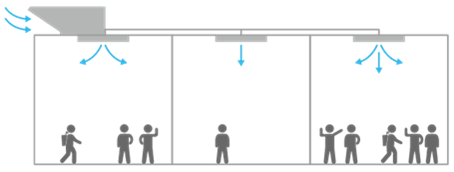
This graphic depicts how a demand control ventilation system may work.
Each room shows different number of occupants in the space and in each
room shows a different level of ventilation, based on the total number of occupants.
Laboratories and medical facilities are often high-ventilation zones. These spaces can be energy-intensive, as minimum air change rates must meet health and safety requirements. But there is a way to find a balance between safety and energy efficiency. Two key solutions are demand control ventilation and effective sash operations.
- Demand control ventilation (DCV) should be used wherever possible, which adjusts ventilation air based on real-time occupancy.
- “Shut the sash” campaigns for fume hood users should be considered. Implementing effective sash operation policies can dramatically improve both safety and HVAC efficiency.
My Green Lab  provides excellent resources for ways to reduce energy use in laboratories.
Explore Heat Recovery Opportunities
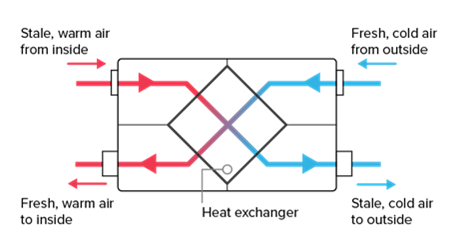
This diagram illustrates a heat exchanger used for ventilation, showing
the simultaneous transfer of thermal energy between two airflows.
It demonstrates how stale, warm air from inside pre-warms fresh,
cold air from outside to maintain indoor temperatures while
providing ventilation.
Heat recovery is the process of capturing and reusing thermal energy that would otherwise be lost to the environment. In buildings, this “waste heat” can be a significant source of energy when repurposed.
- Consolidate exhaust air for airside heat recovery, wastewater heat recovery, and heat recovery from data center waste heat or other high process loads. Typically, exhaust air systems eject valuable heat from the building which can be repurposed through a central ventilation energy recovery system. Heat recovery systems use a heat exchanger to transfer thermal energy, such as using hot exhaust air from building ventilation systems and applying the heat to an incoming air source.
Heat recovery works especially well in higher education environments due to their diverse and simultaneous heating and cooling needs across multiple zones. Heat recovery ventilation is also best suited for cold, relatively dry climates, where it can be most cost-effective during winters. More about heat-recovery chillers is available in HVAC Electrification Strategies.
Consider Humidity Requirements

This graphic depicts a Dedicated Outdoor Air System (DOAS).
Dry outdoor air passes through a cooling pad, causing water
to evaporate, absorbing heat (sensible) and converting it into moisture
(latent) in the air, resulting in cooler, more humid supply air for buildings,
often paired with energy recovery for efficiency.
It’s important to maintain humidity requirements for common space types and special use areas while pursuing energy efficiency strategies. But you can still consider efficient strategies while meeting humidity needs.
- Dedicated outdoor air system (DOAS) can be used to condition and dehumidify ventilation air separately from zone-level heating/cooling.
- Enthalpy-based controls can be incorporated to reduce energy use while maintaining humidity control.
- Desiccant-based dehumidification systems should be considered for very humid environments, as they actively remove moisture from incoming air.
- Adiabatic air conditioning cools and humidifies air by evaporating water using minimal energy. This technology is especially effective in dry environments and can be used to “spot cool” hot areas.
Install Controls
Building controls are excellent systems that can automatically adjust temperatures during unoccupied hours and reset supply air temperatures based on occupancy or scheduling. A building automation system can use pre-programmed controls to adjust lighting, air temperatures, ventilation, humidity levels, and air quality. Additional occupancy-based temperature setpoint controls can help reduce load beyond savings from scheduling.
Convert Stand-Alone Unitary Systems
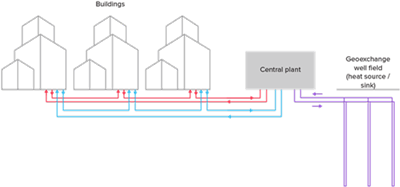
This graphic depicts a schematic of a district heating and cooling
system shows multiple buildings connected by color-coded supply and
return piping to a central plant.
The central plant is linked to a geothermal well field that provides
the thermal energy source.
- Buildings
- Central plant
- Geoexchange well field (heat source / sink)
A unitary HVAC system is a single, self-contained unit providing heating, ventilation, and air conditioning for a building. These systems often operate using fossil fuels and are commonly the least energy-efficient options.
If you have any such systems on your campus, check to see whether you can connect this equipment to a higher-efficiency central plant system. If this is not possible, you may be able to replace the unit with an electric-based system. These are best suited for small loads and back-up heat, especially in colder climate conditions. As ever, don’t forget to deploy load reduction strategies to minimize equipment size.
Optimize the Efficiency of the Central Plant
Advanced control systems monitor and manage the operation of plant equipment and the heating and cooling loads of buildings on campus. Using advanced controls can optimize how much heating and cooling the central plant should deliver at optimal temperatures and time frames when delivery produces the most efficient results. These systems can optimize the operation of chillers, boilers, and cooling towers by coordinating the timing of their delivery to achieve the highest efficiency.
Key Elements to Improve Domestic Hot Water Efficiency
Another energy-saving opportunity is to evaluate your domestic hot water system and look for demand-reduction strategies.
- Heat pump water heaters use electricity to move heat from one place to another instead of generating heat directly. These units, which work like a refrigerator in reverse, are two to three times more energy efficient than conventional electric-resistance water heaters.
- Waste-heat recapture can be used to heat water. Look for opportunities to connect your water heater to the heating system to capture available waste heat.
- Low-flow water fixtures should replace indoor water fixtures and water-using features to reduce water use.
- Instantaneous (tankless) water heaters only heat water when needed, eliminating the energy losses from storing hot water in a tank. They are more compact, reduce standby energy use, and are ideal for applications with variable hot water demand.
- Hot-water temperature resets based on outdoor air temperature or heating load can significantly improve partial-load performance and reduce energy use.
Planning and Next Steps
Reducing energy use is a major factor in developing an overall decarbonization strategy on your campus. Plan to develop and implement these measures prior to making major investments in other decarbonization strategies, such as installing or purchasing renewable energy, heat pumps, or low-temperature hot water systems.
Resources
- NYSERDA: Retro-commissioning
- United States Department of Energy Better Buildings Solutions Center: Decarbonizing the Commercial Kitchen
- Case study: Comprehensive Energy Efficiency Measures at Syracuse University
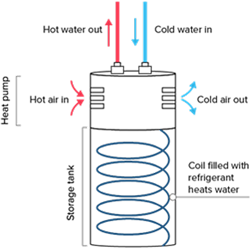
This graphic depicts a heat pump water heater
with a fan and air heat exchange on the left, with
exhaust and intake air indicated by red and blue
arrows.
connected to water piping, with cold water entering
and heated water exiting at the top.
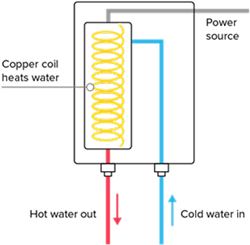
A schematic showing a tankless water heater with
a vertical heating coil, cold water entering from the
bottom (blue upward arrow), hot water exiting
downward(red arrow), and inlet/outlet connections
to domestic water piping at the top.
Connect With Us
Discover how to achieve large energy and carbon reductions across your campus.
Get In Touch