

Financing Mechanisms
Understanding the Different Financing Mechanisms Available for Decarbonization
While investment costs can be intimidating, several funding mechanisms are available to both public and private institutions to lower overall costs. Decarbonization funding demands a well thought-out and researched strategy that considers both environmental objectives and available financial resources. The approach to securing funds can vary based on the specific nature of the project in need of financing. It’s important to also consider your institution’s specific circumstances and needs when determining which financing mechanisms to pursue. Understanding the different financial mechanisms available and identifying decarbonization technologies that need funding is a crucial step in the campus decarbonization process.
Capital Budget
Funding projects using existing capital budget is the simplest way to fund efficiency and electrification projects and it may be pursued with limited internal staff involvement. Keep in mind though, there may be a need for reprioritization of projects extending the timeline for decision making and implementation.
Carbon Charge Fund
Carbon Charge Fund
A carbon charge fund is created through a campuswide program that implements a carbon emissions fee for college departments and tenants. This in turn helps support energy efficiency, decarbonization, clean energy, and research projects. Funds may be directly applied to the capital budget or perpetuated (e.g., a green revolving fund).
Carbon charge funds encourage lower emissions across all campus programs, but may involve additional work, time, and stakeholder approval, if not already in place.
Additional resources
- Internal Carbon Pricing in Higher Education
 : Provides a user-friendly list of resources from implementation guides to program management tools.
Case studies
- Yale Carbon Charge : Explains everything from the role of Yale’s carbon charge and how it works, to the global context.
- Swarthmore’s Carbon Charge Program : Provides an extensive overview of the program structure and collaboration with other institutions.
Endowments
Endowments
Institutional endowments may be applied toward financing direct ownership of decarbonization or energy-generation projects, unless specific restrictions apply. These funds may also be applied toward creating a green revolving fund that continues to pay over time.
Restrictions may exist on investing endowment funds in campus buildings and infrastructure projects. Alternately, they may be allowed as financing, but your institution may have restrictions around the rate of return or payback periods. Plan to discuss this with your CFO for a better understanding.
Additional resources
- Sustainable Endowments Institute initiatives : Offers a detailed list of Sustainable Endowment Institute initiatives.
Case studies
- Caltech Energy Conservation Investment Program : Provides a downloadable case study on the program
- Cardinal Sustainability Fund : Details North Central College’s Green Revolving Fund.
Energy Savings Performance Contract
Energy Savings Performance Contract
Energy service companies (ESCOs) provide energy savings performance contracts (ESPCs) where the ESCO implements the project and guarantees the energy-saving performance. Generally, these companies guarantee the energy and cost savings associated with the upgrades being implemented, and that will cover the cost of the ESCO service.
ESCOs will ensure proper installation and monitoring and will compensate for any deficits if the guaranteed savings are not met. The ESCO carries the performance risk. Equipment under an ESPC is owned by the institution and can be internally or externally financed, and ESPCs are generally suited for longer contract terms and campus-wide scale (higher investment). Contract negotiations can be complex and can extend for several months up to a year.
Additional resources
- Better Buildings Solution Center: Energy Savings Performance Contract : Provides a detailed guide to ESPCs including how they work, how they’re structured, and pros and cons.
Green Revolving Fund (GRF)
Green Revolving Fund (GRF)
A green revolving fund is a capital fund dedicated to projects where part of the cost savings is revolved and applied back to replenish the fund, creating a sustainable long-term mechanism of funding future green projects.
Additional resources
- Billion Dollar Green Challenge : Offers an in-depth overview of the benefits of implementing a Green Revolving Fund.
- Full Implementation Guide : Provides a downloadable guide to implementing and managing Green Revolving Funds.
Case studies
- Billion Dollar Green Challenge : Gives a list of all the colleges who are participants in the Billion Dollar Green Challenge and a case study for each.
Operating Budget
Using the existing operating budget for decarbonization projects is the simplest way of funding projects as it eliminates the need for additional approvals. Incorporating decarbonization and electrification facilitation into typical operations and maintenance projects can reduce the cost of decarbonization over time.
Donations Header
Donations, specifically from sustainability-driven donors, may be used toward electrification and decarbonization upgrades such as all-electric central plants or building upgrades for efficiency, electrification, and net-zero emissions.
Donations may have conflicting priorities with other campus needs however, making it challenging to secure funds for the entire project or phase.
Green Loans
Green loans allow institutions to borrow money at lower interest rates and favorable terms to pay for decarbonization projects. Some loans may offer discounted pricing based on the institution’s energy or carbon performance against set targets that would be verified by a third party on an annual basis. Interest payments, however, will lower energy cost savings.
Additional resources
- Better Buildings Solution Center: Loan or Debt Financing : Provides a detailed guide to loans work including how they work, how they’re structured, and pros and cons.
Case studies
- Green Development Loan for St. Francis Friends of the Poor : Gives a detailed overview of the process, financing, outcomes and more.
On-Bill Financing and Repayment
On-bill financing is when a utility or third-party lender provides funds for capital investment in energy-efficiency and renewable-electricity-generation projects that are repaid as part of existing utility bill payments. These are financed at very low to no interest rates and can be financed without any additional costs.
The contracts are simple in structure, but utilities may have varying specifications and requirements. On-bill financing is also available to leased tenants with the option to pass it on to future tenants.
Additional resources
- Better Buildings Solution Center : On-Bill Financing: Provides a detailed guide to on-bill financing, including how it works, the structure, and pros and cons.
Property-Assessed Clean Energy (PACE)
PACE enables an institution to secure low-cost financing at a fixed rate amortized over up to 30 years and repaid via a voluntary assessment on the property tax bill. This sort of long-term financing transfers with the sale of the property.
Additional resources
- Better Buildings Solution Center: Commercial Property Assessed Clean Energy : Provides a detailed guide to CPACE, how it works, how it’s structured, and pros and cons.
District Energy as a Service
District energy as a service is an emerging path to fund large central plants, district energy generation, and distribution systems. Companies design, build, own, operate, maintain, and optimize the campus’ district energy system at a reliable rate over a fixed span of time. Servicing companies are responsible for uninterrupted service and regulatory compliance.
This path reduces both costs and staffing needs, allowing an institution to shift its focus on other campus infrastructure. Keep in mind though, that the institution cannot earn all associated operational savings in full for the term of contract as these will be mostly directed to the provider as service charges.
Additional resources
- IAE and SEAD Webinar : Explains how cooling as a service is set to revolutionize the cooling industry
Case studies
- Thomas Jefferson University Hospital : Provides a detailed overview of how the hospital benefitted from reliable chilled water service without the upfront capital expense.
Energy (or Efficiency) as a Service (EaaS)
With EaaS, the decarbonization project is designed, implemented, and maintained by the service provider and the institution makes payments based on actual energy at a fixed rate per kilowatt hour. At the end of a contract period, the institution can purchase the equipment, or even terminate the contract and return the equipment.
This is a popular way of financing energy-efficiency and energy-generation projects as an off-balance-sheet financing mechanism (i.e., where there is no asset ownership liability) and is recommended when there are ownership constraints or other conflicting capital priorities.
Additional resources
- Better Buildings Solution Center: Efficiency as a Service : Provides a detailed guide to efficiency as a service, how it works, how it’s structured and pros and cons.
- Energy As a Service, The Ultimate Guide : Explains everything there is to know about energy as a service and details exactly what the process looks like.
Case studies
- Northwestern University : Details using an energy-as-a-service partnership to reduce emissions and train students.
Power Purchase Agreements (PPA)
A PPA is a method of purchasing energy at a fixed rate from a developer that designs, permits, owns, and installs a clean energy system on the institution’s campus or site.
With a PPA, rates are predictable but can sometimes be higher than the market utility rate. Additionally, tax benefits typically go to the developer rather than as direct pay to the institution. Developers can then reduce the PPA rates, though they do not typically pass the full benefits to the institution.
Additional resources
- Better Building Solution Center: Power Purchase Agreements : Provides a detailed guide to PPAs including how they work, how they’re structured and pros and cons.
Case studies
- Steven’s Institute of Technology Babbio Center : Gives a comprehensive overview at how Steven’s used a PPA for energy efficiency upgrades.
Public-Private Partnership
A PPP, or P3, allows an institution to secure capital funding from a private partner and repay it at a fixed rate from savings in operational expenses. This may include continued operational services and can potentially create more opportunities to attract carbon-conscious donors. Efforts may also be aligned with academic or research-based collaboration (e.g., living lab for clean energy research) to expand partnerships.
A High-Level Look at How These Compare
Leasing assets can relieve the burden of liability, ownership, performance risks, and operating and maintaining the equipment. The costs may be covered using internal funds. But if your institution prefers to own its equipment, you may need to consider external financing.
Other factors to consider when determining a financing mechanism include project type, availability of dedicated funds for decarbonization, scale of implementation, and initial project investment.
Figure. — This graphic illustrates where the common financing mechanisms included in the next section fall on a scale of internal to external funding and owned versus leased assets.
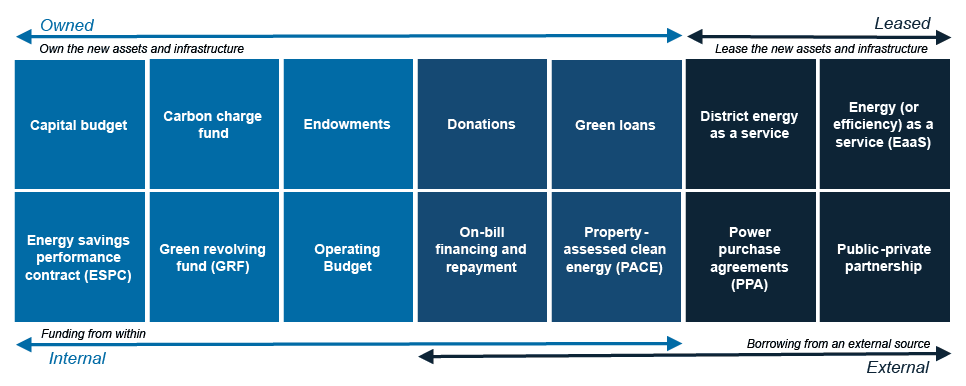
Owned: Own the new assets and infrastructure
Leased: Lease the new assets and infrastructure
Internal: Funding from within
External: Borrowing from an external source
- Capital budget: Owned, Internal
- Carbon charge fund: Owned, Internal
- Endowments: Owned, Internal
- Donations: Owned, Internal/External
- Green loans: Owned, Internal/External
- District energy as a service: Leased, External
- Energy (or efficiency) as a service (EaaS): Leased, External
- Energy savings performance contract (ESPC): Owned, Internal
- Green revolving fund (GRF): Owned, Internal
- Operating Budget: Owned, Internal
- On-bill financing and repayment: Owned, Internal/External
- Property-assessed clean energy (PACE): Owned, Internal/External
- Power purchase agreements (PPA): Leased, External
- Public-private partnership: Leased, External
Connect With Us
Discover how to achieve large energy and carbon reductions across your campus.
Get In Touch