

Energy Storage Strategies
Peak Load Shifting
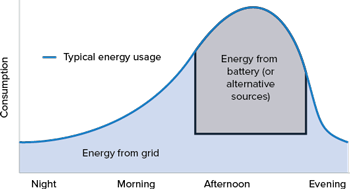
This graph illustrates peak load shifting by showing how energy from a battery or alternative sources can supplement the grid during high-demand afternoon hours. By using stored energy to meet peak consumption, the system reduces the total amount of electricity required from the grid when strain on the infrastructure is highest.
Energy storage solutions allow campuses to store excess energy produced during periods of low demand or high renewable energy generation. This energy can then be used during peak demand when the carbon intensity of the grid, utility prices, and overall energy use are typically higher.
Releasing stored energy during high electricity demand is called peak load shifting, which reduces stress on the local electric grid. Grid electricity also often (but not always) has a lower carbon footprint during low-demand hours.
Types of Energy Storage
Thermal Energy Storage (TES)
TES is useful when the demand for heating or cooling in a building does not match up with the timing of generation. These systems can also be used to store waste heat for later use or to produce hot or cold water if off-peak hours are cheaper. Surplus cooling or heat are stored in anything from ice, glycol, and slush to molten salt, earth, and bedrock. TES efficiency is closely tied to thermal massing—i.e., the larger the better. TES can therefore take up a considerable amount of space and may not be a good fit for every building or campus. There are three types of TES:
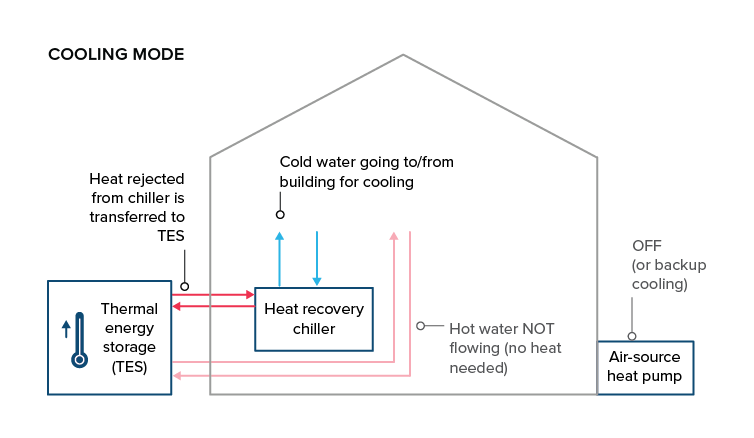
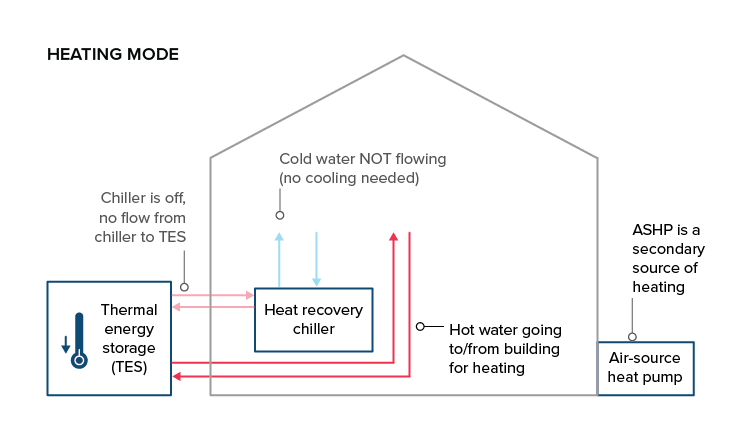
Heating hot water storage is one of the most flexible thermal storage approaches, especially when it is equipped with a heat recovery chiller and air-source heat pump backup system. The hot water storage tank captures waste heat and stores excess heating energy in water, increasing overall heating system efficiency and providing hot water when required.
Cooling Mode
A schematic of a building cooling system using thermal energy storage shows chilled water supplied from a storage tank to an indoor cooling unit, with blue arrows indicating cooling delivery and red piping showing return flow. In cooling mode, hot water circulation is inactive, and a backup cooling system is shown off to the side for supplemental use if needed.
Heating Mode
A schematic of a building in heating mode shows hot water circulating to the indoor heating unit (red arrows) while cold/chilled water flow is shut off since no cooling is needed. The chiller and thermal energy storage are inactive, and heating is provided independently, with backup equipment shown off to the side.
Chilled water storage systems use cooler nighttime ambient air and/or cheaper nighttime electricity to produce chilled water, which increases overall system efficiency. This stored cooling energy is then released during the day as needed.
Ice storage is commonly paired with a chilled water system. It uses electricity and phase change to store cooling energy during off-peak hours (nighttime) when outdoor air is cooler and demand rates are lower, then releases it during peak demand periods when energy costs are high. Because ice storage uses the latent energy of the phase change from water to ice, this system offers an efficient and space-saving way to store cooling energy.
Battery Energy Storage Systems (BESS)
Battery Charging and Discharging
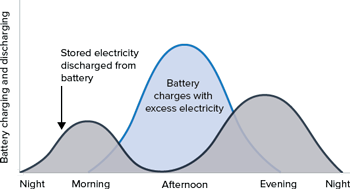
This graph illustrates the daily cycle of battery charging and discharging to optimize energy usage. It shows the battery charging with excess electricity during the afternoon and discharging that stored energy to meet demand during the night, morning, and evening.
BESS usually use lithium ion or lithium iron phosphate (LiFePo) batteries. They integrate well when paired with onsite renewable energy systems (such as solar PV, wind, or solar thermal) to increase the flexibility of the overall energy system. By storing excess energy generated during periods of high renewable output, the system can supply stored energy to the building during peak times which can lower demand charges and decrease grid stress by reducing the building’s load on the grid.
Additionally, BESS’s can serve as back-up power sources should grid power be interrupted and can be configured to support the grid on behalf of the servicing utility, which is a potential source of revenue. These systems can also improve campus power quality, which may be an important consideration for sensitive loads such as medical facilities, laboratories and data centers. Battery storage efficiency is not driven by size the way thermal energy storage is but can also take up a considerable amount of space.
How to Evaluate Storage Solutions
Perform a Financial Analysis
Quantify heating and cooling loads during each season to assess the cost-effectiveness of energy storage by reviewing trend data on a facility’s building automation system (BAS) or energy management system (EMS). The most helpful metric to use is the peak-to-average load ratio. To calculate this, evaluate the facility’s peak heating/cooling load compared to the average monthly and daily loads. Investing in energy storage makes the most sense when the facility’s peak loads significantly exceed the average loads.
Perform a Financial Analysis
Perform a comprehensive life-cycle cost analysis (LCCA) of the storage system to quantify the total cost of ownership of the system over its lifespan. This process should account for factors such as:
- First costs
- Annual energy costs
- Annual energy savings
- Carbon emissions reductions and related cost savings
- Inflation
- Maintenance costs
- Expected equipment replacement cycles
- Annually escalating energy prices
- Peak demand charges
- Time-of-use (TOU) tariff structures
Since storage strategies are most beneficial during hours when energy prices are highest, you should account for peak demand charges instead of using average energy rates or blended utility rates.
Evaluate Your Energy Storage’s Impact on Emissions
An energy storage system can help reduce your campus greenhouse gas emissions. The amount an energy storage system can reduce carbon emissions depends on the source of electricity used to charge the system. For example, an electric battery system charged with the local electricity grid’s power at a time when the grid is “dirtier” (e.g., during peak use) will have higher emissions than an electric battery system charged with solar power. To ensure emissions reduction, design the storage system to operate with a charging scheme that leverages times when the grid has a lower carbon intensity. Include this in your carbon impact evaluation.
Tools such as NREL’s REopt (Renewable Energy Optimization) model energy storage systems while factoring in grid emissions intensity, providing support in designing charging schemes that minimize emissions. REopt also assists campuses in identifying the types of engineers and professionals needed to design and implement cost-effective energy storage solutions.
Assess Existing Equipment and Physical Constraints
Site limitations can be a barrier to energy storage options. Evaluate energy storage systems within the context of existing equipment, physical constraints, and future plans. For example, when considering adding heating or cooling capacity, thermal storage can be more cost effective than adding new equipment to achieve the additional capacity. Physical space constraints mean the size of components like thermal tanks and electric batteries are important to assess. Furthermore, future onsite renewable energy systems could shift peak draw time from the grid, so take near- and long-term scenarios into account.
Integrate Storage With On-Site Renewable Energy Systems
As mentioned above, energy storage is especially effective when closely paired with on-site renewable energy generation. The largest benefit occurs when multiple buildings’ systems are integrated with the total campus’ energy load profile in mind. With this approach, assets from one building—such as plentiful storage or excess energy generation—can benefit surrounding buildings, resulting in lower overall emissions.
These illustrations depict a campus energy system built with the total campus' energy load profile in mind. Read more in the UAlbany case study.
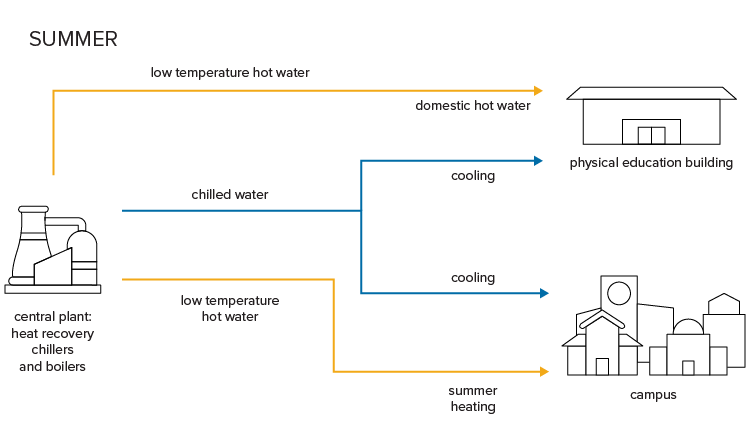
Summer Campus Energy System
Central Plant: Heat Recovery Chillers and Boilers:
- Low Temperature Hot Water
- Domestic Hot Water
- Physical Education Building
- Domestic Hot Water
- Chilled Water
- Cooling
- Physical Education Building
- Campus
- Cooling
- Low Temperature Hot Water
- Summer Heating
- Campus
- Summer Heating
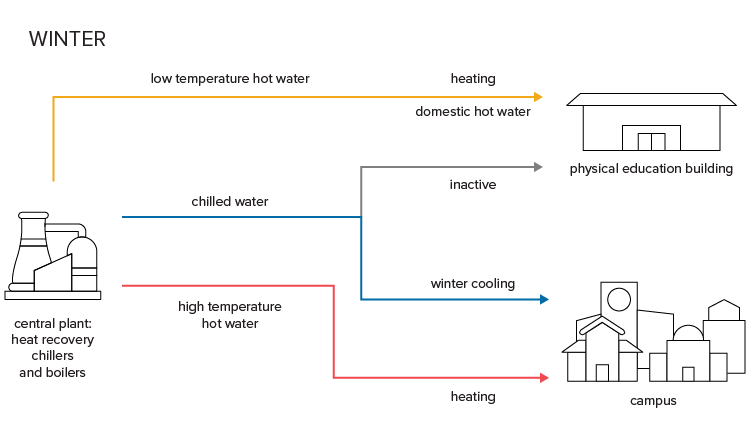
Winter Campus Energy System
Central Plant: Heat Recovery Chillers and Boilers:
- Low Temperature Hot Water
- Heating & Domestic Hot Water
- Physical Education Building
- Heating & Domestic Hot Water
- Chilled Water
- Inactive
- Physical Education Building
- Winter Cooling
- Campus
- Inactive
- High Temperature Hot Water
- Heating
- Campus
- Heating
Consider Resilience and Utility Grid Stability
Both thermal storage and electric battery systems will enhance campus energy reliability, which is especially important for campuses with healthcare, laboratories, or data center facilities. As climate events become more severe, storage strategies offer solutions for enhancing local grid resilience and stability. Consider storage solutions as part of a comprehensive risk and resilience evaluation.
Consult With Your Servicing Electrical Utility
To maximize the value of energy storage, consult with your electrical utility on when to take advantage of the least expensive power. Known as energy storage arbitrage, this technique uses a system that pulls grid energy when the grid carbon intensity or electricity prices are lowest and stores it for use when the grid carbon intensity or prices are highest. Your servicing electrical utility may have valuable input on reducing grid stress. Coordinating with them early in your project development can maximize the impact energy storage systems have on campus energy resilience.
Planning and the Bigger Picture
Consider storage strategies as part of a holistic campus strategy throughout your decarbonization journey. Consider load shifting at the individual and campus levels and timing of these interactions. Campuses are ideal candidates for storage strategies due to their diverse load profile, the proximity between buildings that can enable load-sharing, the prevalence of existing district energy systems, and the potential for on-site renewable energy systems.
Overall, energy storage can lower energy- and carbon-related costs, reduce emissions, and enhance local grid stability and long-term resilience.
Resources
Connect With Us
Discover how to achieve large energy and carbon reductions across your campus.
Get In Touch