

Building Envelope Strategies
Improving your building envelope is crucial for decarbonization because it’s the most effective way to lower a building’s energy demand for heating and cooling, which are major sources of greenhouse gas emissions. This page will look at other key benefits along with a list of actionable strategies for building envelope improvement.
Key Benefits of an Improved Building Envelope
- Reduced energy consumption
- More cost-effective electrification
- Increased building resilience
- Enhanced effectiveness of other systems
- Improved comfort and health
- Reduced waste
Strategies to Improve Building Envelope
Surpass Minimum Code Compliance
Energy codes are minimum energy-efficiency requirements and building design specifications for all new and substantially renovated buildings. Codes are updated over time to require increased energy efficiency for building envelope components, assemblies, and installation techniques.
To maximize efficiency, aim for a higher standard of envelope performance than the latest energy code requirement—but be sure to balance efficiency with your building’s appropriate humidity levels and occupant comfort.
Strategies to surpass minimum code compliance:
- Review local and state energy codes (e.g., ) to inform performance and materials specifications.
- Review other standards, guidance, and benchmarking systems such as New York City's 2020 Energy Conservation Code
 , ASHRAE 90.1 , LEED , Passive House , and ENERGY STAR® . They provide frameworks for assessing the energy consumption of building designs.
 - Create energy models to help you evaluate designs and materials against these standards and consider all opportunities to reduce the building energy footprint and optimize performance, and to understand the tradeoffs on cost and performance.
Minimize Air Leakage
Tightly sealed construction reduces energy losses, maintains indoor thermal comfort, preserves indoor air quality, and minimizes drafts. Caulking, weatherstripping, and air barriers all help minimize air leakage.
You can verify the integrity of the building envelope through blower door testing, infrared thermography, and smoke testing. These methods can help identify and quantify air leakage pathways by measuring pressure differentials and temperature variations caused by air infiltration.
Air infiltration or leakage typically occurs at joineries between roofs, walls, windows, floors, and doors. Multiple techniques can control moisture and prevent or minimize air leakage across the building envelope, including ensuring a continuous air barrier.
Strategies to minimize air leakage:
- Install high-performing windows which can achieve U-values and solar heat gain coefficients (SHGC) that align with or outperform energy code standards when they are tailored to the climate zone and building orientation. Triple glazing, argon gas, thermally broken frames, and low-emissivity (low-e) window coatings also significantly enhance thermal resistance, limit solar heat gain, and reduce air infiltration.
- Install high-performance doors that have insulated cores, airtight seals, and thermally broken construction. They work seamlessly with wall assemblies to prevent moisture and maintain the integrity of the envelope.
Reduce Heat Loss
Effective insulation reduces heat loss through roofs, walls, floors, and doors, which improves overall energy efficiency by reducing heating and cooling loads.
Strategies to reduce heat loss:
- Use continuous insulation to extend across all structural components, effectively addressing heat loss caused by thermal bridging. Systems such as exterior insulation finishing systems (EIFS) and insulated sheathing ensure consistent thermal resistance across the entire envelope while reducing the risk of condensation.
- Opt for thick layers of dense insulation to enhance thermal performance.
- Improve R-values and U-values. Thermal bridging can occur anywhere in the envelope, from wall penetrations by screws, nails, and other types of anchors to metal window frames. Insulation performance standards are dictated by code requirements and are measured by metrics called U-values and R-values. When improving envelope construction, increase the R-value of insulation and increase insulation thickness to improve the resulting U-value.
Again, make sure that retrofit applications improve upon minimum code requirements (e.g., ASHRAE 90.1 , International Energy Conservation Code , local codes) to maximize efficiency.
This illustration depicts strategies to prevent air leakage and heat loss in a building.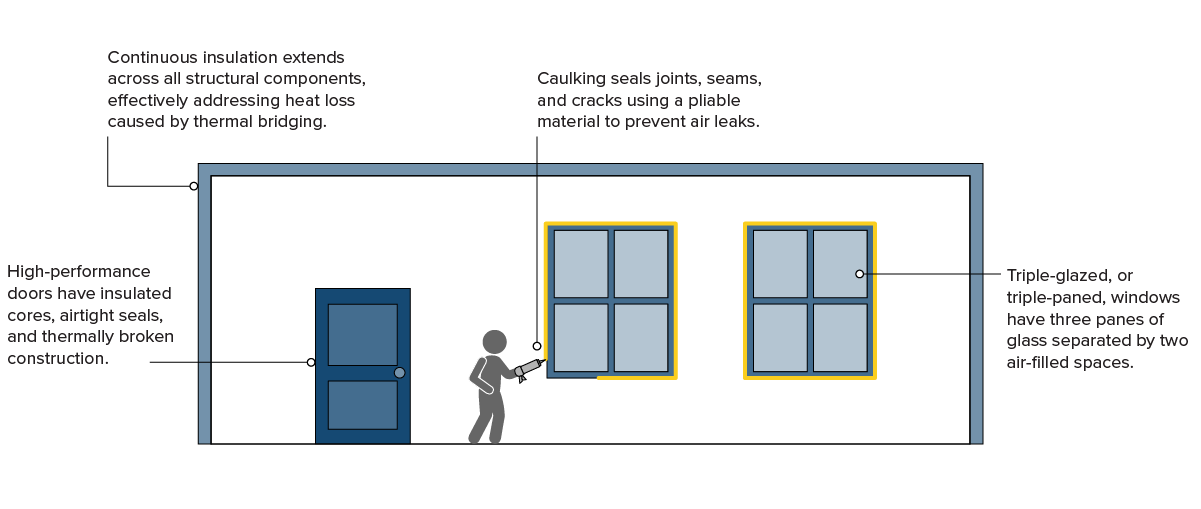
- Continuous insulation extends across all structural components, effectively addressing heat loss caused by thermal bridging.
- High-performance doors have insulated cores, airtight seals, and thermally broken construction.
- Caulking seals joints, seams, and cracks using a pliable material to prevent air leaks.
- Triple-glazed, or triple-paned, windows have three panes of glass separated by two air-filled spaces.
Control Solar Heat Gain
Control Solar Heat Gain
In new construction, building orientation and design make a significant difference in how sunlight and wind play a role in heating and cooling a building naturally. Proper shading reduces cooling needs in summer while allowing beneficial sunlight in winter, improving comfort and efficiency.
Several strategies can help to control solar heat gain:
- Opt for window glazing which includes technologies such as tinted or reflective glass, varying pane thicknesses, multiple glazing layers, and air- or gas-filled cavities—can significantly impact solar heat gain. When replacing windows, high-performance models with a long life expectancy offer the best savings over time. Alternatively, window films are a lower-cost solution.
- Consider Internal shading such as roller shades and louver blinds, which can be combined with external solutions to allow the occupant to tailor individual shading and lighting needs depending on the time of day.
- Consider external shading solutions such as overhangs, horizontal louvers, vertical fins, and other creative architectural features, which can serve as creative visual features.
- Choose reflective roofing materials to minimize solar heat gain, resulting in substantial energy savings in hot climates by reducing cooling loads. They are also effective in mitigating the urban heat island effect in densely built environments. In colder climates, reflective roofing materials may help heat buildings during the winter months, but this impact is insignificant when compared to the impact of additional insulation. Prior to installing reflective roofing materials in northern climates, it is important to evaluate factors such as roof insulation levels, the extent of conditioned areas, occupancy patterns, anticipated cooling energy savings, and potential heating energy penalties.
- Consider installing a building automation system, which can dynamically adjust internal and external shading to changing sunlight conditions to increase energy efficiency, reduce glare, and maintain natural daylighting.
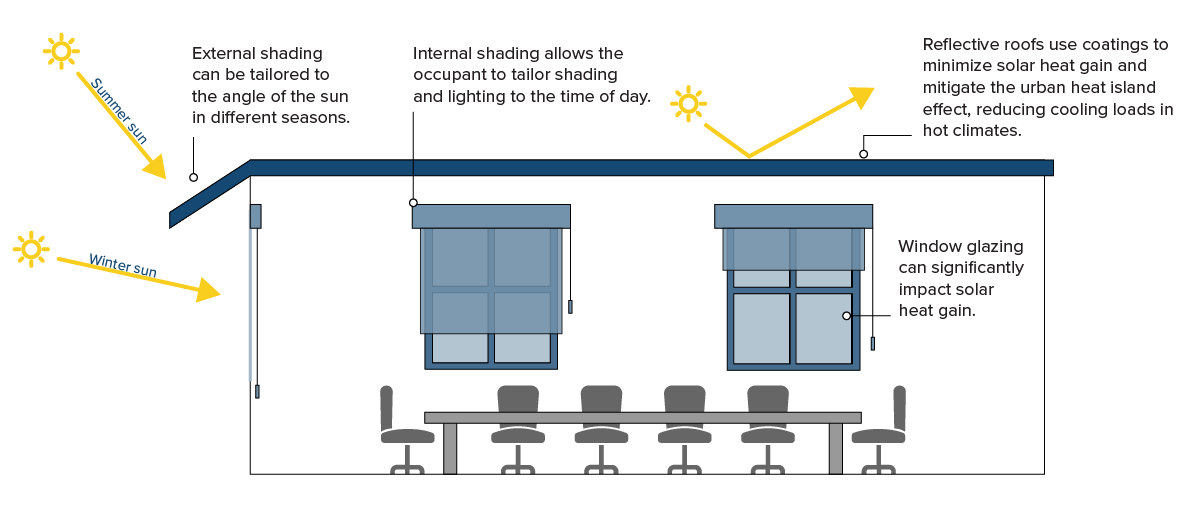
This illustration depicts strategies to control and optimize solar heat gain in a building.
- External shading can be tailored to the angle of the sun in different seasons.
- Internal shading allows the occupant to tailor shading and lighting to the time of day.
- Reflective roofs use coatings to minimize solar heat gain and mitigate the urban heat island effect, reducing cooling loads in hot climates.
- Window glazing can significantly impact solar heat gain.
Observe Historical Requirements
Sometimes building retrofits must maintain the historical aesthetic appearance and character of a building’s exterior façade. This is particularly true of buildings listed on the National Register of Historic Places or the New York State Register . Be sure to gain an understanding of your historic preservation guidelines and standards to ensure your energy-efficiency retrofits align.
In some cases, you may want to consult with a historical building specialist to develop solutions that can pass historic preservation review. You may also need to work with the local historical preservation board to determine if they can make exceptions or approve of creative alternatives. Sometimes exceptions are made for sides of buildings that do not face a street or other public space. Internal retrofits are typically easier to gain approval to implement in historic buildings.
Planning and the Bigger Picture
Improving the building envelope should align with existing campus-wide improvement plans, equipment upgrades, or renovation cycles.
For example, during a space reconfiguration, if the program and floorplan are undergoing modification and design loads are reevaluated, this is an ideal time to add insulation or make other envelope improvements. These upgrades can reduce the load for newly configured spaces and ensure the building performs efficiently.
Strategies that improve the building envelope also reduce heating and cooling loads, which can allow you to downsize your HVAC systems. This integration ensures lower electrical loads and optimizes energy consumption, aligning with long-term sustainability goals. This is particularly timely when planning for major HVAC retrofits where poor envelope design and performance will increase the size of air-source heat pump modules or additional and expensive ground-source heat pump loops.
Resources
Connect With Us
Discover how to achieve large energy and carbon reductions across your campus.
Get In Touch