

Covering Decarbonization Costs
Understanding the Basics of How Higher Education Institutions Can Pay for Projects
Investment costs and project priorities can heavily influence decision making. If not discussed early and often, they can substantially slow down your decarbonization journey.
Institutions have finite resources. Existing or planned projects could potentially conflict with decarbonization needs and goals. Debt limits can further minimize the possibility of taking on additional loans or seeking external financing.
While investment costs can be intimidating, several funding mechanisms—including federal, state and local incentives, tax benefits, rebates, and grants—are available to both public and private institutions to lower overall costs.
The remaining cost of the project will then be covered by other financing mechanisms, such as bonds and endowments, with rebates paid to the institution upon equipment purchase or project completion.
Additionally, coincident decarbonization opportunities can be addressed through a strategic planning and implementation process. These can and should be integrated into equipment replacement projects or the next major building retrofit. Learn more about your options for covering decarbonization project costs below.
Financial Pathways for Academic Institutions
1. Bonds
Universities can acquire project financing via bonds through multiple different organizations such as SUCF, CUCF, DASNY, and their local municipality depending on the type of university they are. This is a relatively low-risk way to finance a project and is common practice in the SUNY and CUNY systems.
- State University Construction Fund (SUCF)—non-residential SUNY projects
- City University Construction Fund (CUCF)—non-residential CUNY projects
- Dormitory Authority of the State of New York (DASNY)—residential for SUNY, CUNY, or private non-profit projects
- Municipalities—community college or private non-profit projects
2. Endowment
Revenue generated primarily through charitable donations that can be required to be used in a specific way, such as research or scholarships; however, institutions typically have a general endowment fund that they can use for investments and general operating costs. This is the primary way private institutions fund projects without requiring an external loan. See Common Financing Mechanisms for more details.
3. External Contracts
There are many companies that are willing to cover the costs of these investments upfront on behalf of the institution. These contracts typically come with payment plans and differing terms depending on the level of ownership the institution requested.
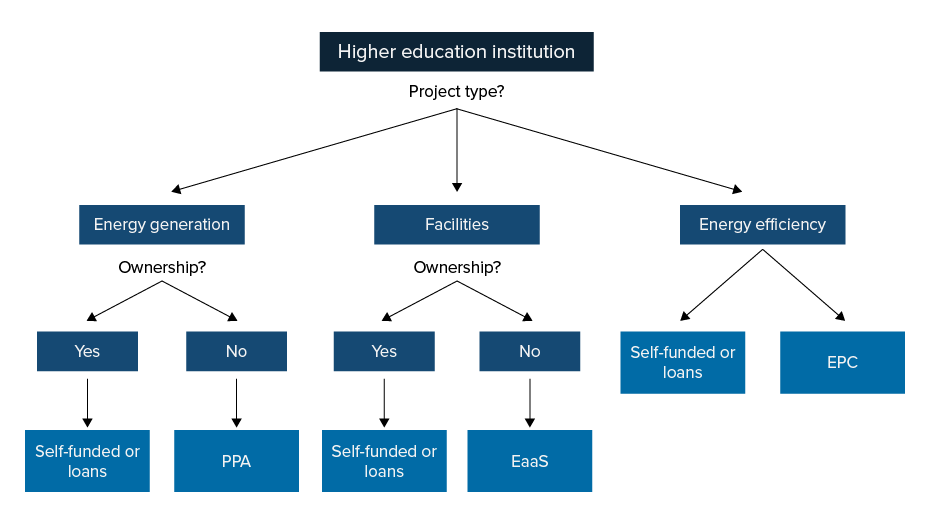
Some contracts, such as power purchase agreements (PPAs) or energy-as-a-service (EaaS) agreements, result in the university having access to leased equipment. Alternatively, some companies provide an energy performance contract (EPC), which allows the university to retain full ownership over the equipment. The company will typically install the agreed-upon project and guarantee a minimum amount of energy savings associated with the improvements. See Common Financing Mechanisms for more details.
4. Tax Benefits (Traditional)
Tax credits and deductions can come from the local, state, or federal level. Each credit and deduction have their own form, required documentation, and specific terms associated with it. Traditionally, non-profit entities were unable to directly receive benefits from tax credits and deductions. Other contracted entities (such as designers, contractors, and developers) were able to receive these benefits with a potential to pass cost savings to the owner; however, the Inflation Reduction Act of 2022 (IRA) provided a pathway for non-profit entities to directly receive monetized tax credits through elective pay.
5. Tax Benefits (Elective Pay/Direct Pay)
The IRA provided the ability for certain tax benefits to become available as a direct payment to non-profit entities, including universities. Unlike traditional tax credits, tax-exempt entities can acquire these benefits as a direct payout after the installation is complete. A university may also be able to transfer this credit to a contractor or other third-party entity and be provided to the university in the form of a discount on services rendered.
While a tax consultant should be advised for specific situations and applicability, the IRS provides additional information for elective pay(opens in new window).
6. Rebates
In the state of New York, rebates are generally provided by your local utility company or, in some rare cases, directly from state agencies. Each rebate has specific requirements that must be met, including things such as existing-condition walkthroughs, inspections, copies of equipment invoices, or energy savings calculations. These payouts are usually given at the completion of a project as an incentive to install particular types of equipment.
7. Grants
Grants can be acquired from local, state, federal, or even non-profit organizations. Generally, each grant will have an application associated with it. The grant is either non-competitive or competitive. Non-competitive grants are easier to solicit due to the high chance of success, easily quantifiable rewards, and clear directions. Competitive grants tend to have larger payouts but are more of a gamble. Professional grant writers can be helpful in applying for grants.
Grants are also an excellent opportunity to collaborate with academics and research to advance campus-as-a-living-lab initiatives. Institutions can prepare for these opportunities by encouraging researchers, facilities teams, and energy, sustainability, and decarbonization staff to identify shared areas of interest that can advance both research and institutional needs. These opportunities often arise quickly; early alignment can help identify any required matching funds and other internal approvals.
Identification of a Financial Path Forward
The greatest impediment to decarbonization projects moving forward is the perception—valid or invalid—that there is not enough funding to cover the costs. Explore Programs, Incentives, and Access Grants will outline some of the funding streams and strategies available for higher education institutions. Reach out to your chief financial officer (CFO) to discuss your institution's typical financing practices. See Meet with Your Finance Team for suggestions around framing this discussion.
Additionally, SUNY and CUNY institutions should reach out to their central administrative staff for the most recent and accurate information regarding financing practices.
The following is a decision tree for project funding based on project type and ownership information.
Connect With Us
Discover how to achieve large energy and carbon reductions across your campus.
Get In Touch